By Johanna Isaacson
What do we want for our futures— communities built on freely chosen love and care or a society built on the threat of expulsion and violence? As I write this question, the battle against “cop city” in Atlanta Georgia unfolds to provide a stark example of the two paths. Protesters have set up an encampment to contest a plan to build the most extensive police training facility in the US, which will destroy the environment and people alike, supporting deforestation, criminalization, and police violence, as has already begun with the execution of the gentle protester known as Tortuguita.
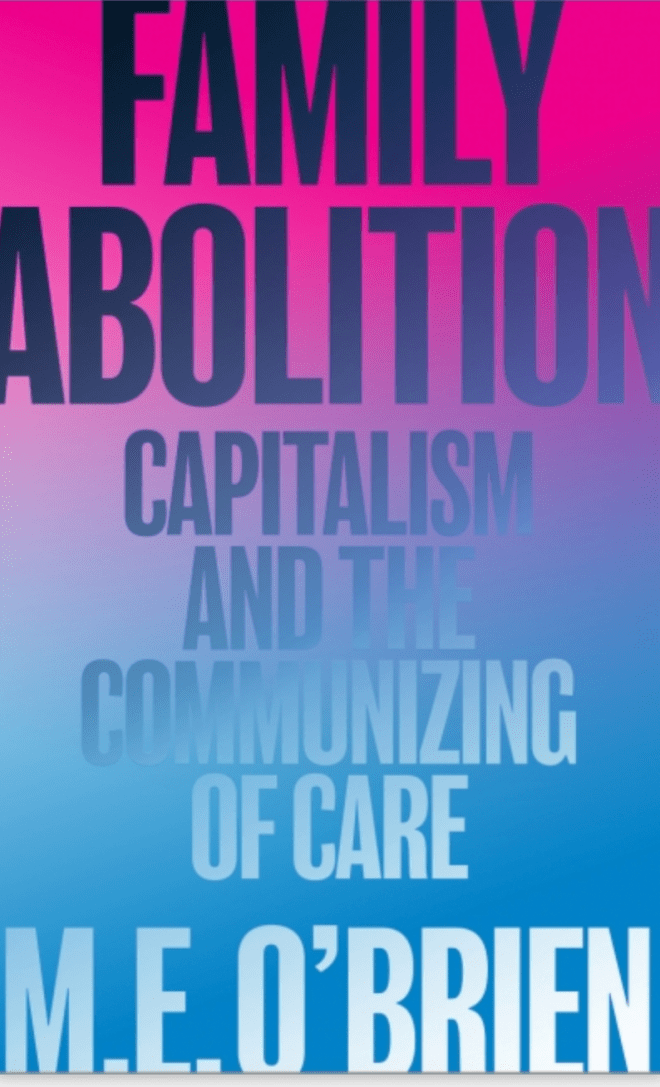
Those who want to combat this institutional entrenchment of systemic violence haven’t only been stating their beliefs and putting their bodies on the line at protests. They have also been living together in the forest they are trying to protect, building a prefigurative community based on love and care—feeding each other, creating a medic station and a “free store,” making music, dancing, mourning their dead. This relationship suggests that these protesters are what we consider a family, and M.E. O’Brien would agree that the love and common goals that bond this group together fulfills the best promises of the family. However, in her new book published by Pluto Press, Family Abolition: Capitalism and the Communizing of Care, she distinguishes the “insurgent social reproduction” of the protest encampment from the privatized family, where daily tasks are often done in isolation and under coercion.
The book introduces its themes through the model of the Oaxaca commune, an encampment that blossomed from a teachers’ strike into an anti-authoritarian uprising coordinated by a wide variety of movements. To support these protests, many militants not only built barricades but lived at them full time. The women who participated in these encampments, O’Brien argues, modeled family abolition in action as they took a stand “against both abusive husbands and racist, anti-indigenous, anti-worker state forces.” Instead of individually reproducing the private household, women worked collectively, publicly, and with shared intimacy, “reproducing the insurrection.”
The women of the Oaxaca commune are examples of how family abolition is not, as some may fear, a threat to deny and deprive people of care, but rather the opposite, a vision of a vastly expanded realm of nurturing and love. To explore this potential, Family Abolition is structured in three parts: one that outlines the horrors of and means of escape from “the impossible family,” a second that ambitiously outlines “a history of family abolition,” and a third that even more bravely dares to imagine post-family possibilities “toward the commune.”
O’Brien begins by exploring the current crises of the family in the private household, as so baldly exposed by the coronavirus pandemic lockdowns. This crisis exacerbated contradictions within the family that relies on the private household to provide unpaid reproductive labor that makes capitalist production possible while denying the family the resources needed to make this possible. O’Brien shows the ghoulish, racialized implications of the death drive at the heart of these contradictions, examining a publicity photograph that depicts Donald and Melania Trump holding a Latinx baby whose parents were killed in a racist mass shooting. Here, the normative family is explicitly shown as reliant on racial violence.
O’Brien goes on to imagine “lines of flight,” offering George Floyd’s last, heartrending call for his mother as a vision of how care and love could exceed the current meaning of the family. Taking the mothering love that Floyd called for as “salvation, aid and care,” she goes on to imagine what could happen if as a society, we committed to generalizing that compassion and support to address “the profound pervasive care crisis of capitalist society.” Family abolition is here revealed as more than destruction, but a kind of transformation, as can be seen in Black freedom struggles, revolutionary Marxist thought, and other radical traditions. O’Brien has no interest in diminishing care. Rather, she wants to liberate care from scarcity, imagining care’s potential as a decommodified resource that would allow us to decouple the desire to give and receive love from alienation and coercion.
O’Brien’s framing of “family abolition” is clarifying and original; however, the concept is not new. In part two of the book, she provides a richly researched history, tracing how family abolition evolves as the family’s utility to racial capitalism historically transforms. She looks at how, from capitalism’s inception, workers rebelled against normative family forms, exploring Marx and Engels’ critique of the bourgeois nuclear family as well as the attack on kin relationships under slavery and the subsequent Jim Crow-era enforcement of monogamous heteronormative family forms on Black people. She offers glimpses of transgressive proletarian practices, including sex work, gay sex, trans self-presentation, and resistance to racialized family structures.
O’Brien goes on to explore the vicissitudes of the family form through different stages of the workers’ movement. This includes the adaptation of late 19th century working class households to the bourgeois form of the single-waged nuclear family. But she also explores socialist critiques of and experiments with conventional family forms, aimed at collectivizing household labor. Radicals of the “Red Decade,” a period from the mid-sixties to mid-seventies, also interrogated family conventions, such as housework and housewifization. O’Brien looks at “Red Decade” critiques, focusing on the Wages for Housework movement that offered solid analysis of reproductive labor on which to found a family abolitionist politics.
Bringing us up to the present, O’Brien concludes part two by asserting that even as the housewife form of the family is no longer generalized, this has not liberated working class people from the tyranny of the gendered private household. Rather, global economic crisis has led to an intensification of pressure on the private household. O’Brien notes that many analyses stop with the present and refrain from speculating about the future, and that this can be a wise choice, leaving open the possibility for unimaginable futures. However, she feels it’s worth the risk to imagine a future that is not simply slightly better, but fully transformed. So much of the rage aimed at family abolition stems from the assumption that it would erode the forms of intimacy that sustain us, but O’Brien wants to emphasize that the concept is rather “a call on every one of us to imagine, to debate, to think about what social forms could foster lives worth living.”
In that spirit, she dares to imagine unthinkable possibilities that begin with a promise of “unconditional access to the means of survival.” This would liberate us to spend more time with biological family if we wished, or to seek out other forms of intimacy. The most stark examples of the family’s shortcomings are the constraints that traditional families put on those who seek gender and sexual freedom, which is one reason why trans critiques coming out of various anti-capitalist traditions provide some of the most acute analyses of this toxic institution. Family abolition is not simply liberation from the violence that can occur behind closed doors, but freedom from prescribed gendered roles and behavior, enabling a queer futurist plethora of possibilities and intimacies that we cannot yet imagine.
Along with trans anti-capitalist critiques, protest camps, such as the example of the Oaxaca commune pointed to in the book’s introduction, allow prefigurative family abolition imaginaries, as they deprivatize labor and relationships that are typically hidden behind the walls of domestic dwellings while connecting relations of care to struggle for a transformed future. O’Brien is inspired by the possibilities suggested by these protest camps but still sees the limits of prefiguration when circumscribed by capitalist structures and logics. To imagine a world beyond our present constraints, she ventures to think through a blueprint of the commune as a means of family abolition, building on the political tradition of communization to envision “the specific revolutionary undoing of the relations of property constitutive of the capitalist class relation.”
She imagines this developing during waves of insurrection against capitalist structures. Ongoing rebellion would enable people to collectively deprivatize “public” space and goods, caring for each other while setting up expansive protest kitchens, medical services, and alternative uses for infrastructure, farms, and factories. In this transformed landscape, social reproduction would be generalized and transformed, offering care without coercion. For an elaborated narration of this vision, everyone should read Everything for Everyone: An Oral History of the New York Commune, 2052-2072, a stunningly ambitious speculative utopian novel cowritten by O’Brien and Eman Abdelhadi.
O’Brien’s desire for a “beloved community” can come across as theological, and that seems to be intentional. Instead of repressing theological hope, she brings it in dialogue with her political and economic concerns. Turning toward a radical current in Martin Luther King’s thought, she shows how spiritual aspiration for an ever-expanding realm of love may inspire material transformation.
As both O’Brien and Sophie Lewis, author of Abolish the Family, suggest, family abolition is not aimed at simply destroying the family, but transforming it, preserving the love and care that the family promises, while negating the coercion and scarcity that too often becomes its reality. A deep engagement with this work will discover that all the best aspects of the family are preserved in family abolition, while the pressures and prejudices inherent to a system reliant on privatized care are dissipated.
Recently, I was enjoying a summer evening relaxing with my neighbors and dear friends. As my friend and I talked, her five-year-old daughter sat on her lap cuddling and nuzzling her. My friend managed to conduct an “adult conversation” while pausing frequently to affirm her daughter, joke with her, and give her physical affection. I felt genuinely warmed by the palpable love flowing between them, and grateful to be included in their circle of care. Few would deny that this relationship between my friend and her child should be supported and celebrated. But many do not then ask the next, pressing questions. How can we support this family so that they can experience this intimacy more frequently and freely rather than beset them with the punishing demands for money and labor that accompany parenthood under capitalism? How can we build a society where those in “dysfunctional” families still have access to this kind of care and love?
In O’Brien’s magnificent book, the concept of family abolition is a provocation to take these questions seriously, and to dare to call the bluff of the family. If the family is our most precious institution, why can’t we prioritize its promise of nurturing and care in every dimension of society? Why does the family have to remain the “heart of a heartless world” when we have the option to transform the world in its entirety into a circulation of “generalized human care and queer love” rather than cold cash and commodities? Instead of huddling in our fragile, darkened homes, why can’t we emerge and bask in the warmth of a sunlit beloved community?
Author bio: Johanna Isaacson writes academic and popular pieces on horror and politics. She is a professor of English at Modesto Junior College and a founding editor of Blind Field Journal. She is the author of Stepford Daughters: Weapons for Feminists in Contemporary Horror (2022) from Common Notions Press and The Ballerina and the Bull (2016) from Repeater Books. She has published widely in academic and popular journals including, with Annie McClanahan, the entry for “Marxism and Horror” in The Sage Handbook of Marxism (2022). She runs the Facebook group, Anti-capitalist feminists who like horror films.
 blindfieldjournal.com