By Johanna Isaacson
In classic feminist films, the kitchen is a place of repetition whose Sisyphean tasks incrementally arouse dread and terror in the entrapped homemaker. Not so in the 1984 film Gremlins. There, even before it is overrun by monsters, the kitchen is a site of explosive violence, where the myth of the happily gendered family is splattered across linoleum floors and formica countertops.
Gremlins tells the story of the Peltzer family on a fateful Christmas eve. Mr. Peltzer, a bumbling inventor, finds himself in a Chinese junk shop where he encounters a creature called a mogwai. The store owner, Mr. Wing, refuses to part with the adorable furball, but his grandson is worried about money, and secretly sells it to Mr. Peltzer, with instructions to keep it from light, water, and food after midnight.
Regardless, Mr. Peltzer’s teenaged son, Billy, soon allows the creature (who they name Gizmo) to get wet, causing it to multiply. While Gizmo is gentle, his spawn are little terrors who trick Billy into feeding them after midnight, catalyzing their metamorphosis from cute, furry creatures to slimy, reptilian gremlins.
From there, the rambunctious little devils dismantle the Peltzer house and go on to attack the whole town, multiplying exponentially. Finally, Billy and his love interest, Kate, manage to hunt down and kill the gremlins with the help of Gizmo. The film ends with the return of Mr. Wing who reclaims Gizmo, scolding “You do with mogwai what your society has done with all of nature’s gifts.” He concedes that Billy, who has treated Gizmo with respect, may someday be ready for this wondrous bond.
As can be seen, a lot happens in this film, and yet a scene taking place in the Peltzers’ kitchen has captivated audiences and critics more than any other. In fact, the scene is so violent and impactful that it helped change the U.S. film rating system, spurring the creation of the PG-13 designation.
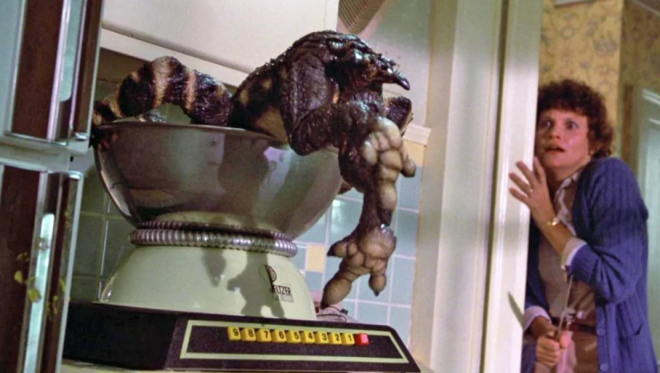
Even though Mrs. Peltzer is a minor character, she gets the film’s coolest kills when she discovers the gremlins wreaking havoc in her kitchen and eating her gingerbread cookies. Swiftly taking her disproportionate revenge, she kills one gremlin in her mixer, knifes another, and microwaves a third until it explodes. Appliances meant to ease the life of the homemaker are here used to murderous ends. But even before her kitchen is covered with green bloody slime, it’s a confusing space.
Clues about why the Peltzers’ seemingly idyllic fifties style kitchen is riddled with contradictions are present as soon as the film begins. Mr. Peltzer’s financial insecurity is the first hint. He didn’t enter Mr. Wing’s shop intending to buy anything, but rather to sell his own invention. His pitch for this gadget, the “bathroom buddy”—the kind of gimmick that could be sold on QVC, as Ash and Jon from the podcast Horror Vanguard joke— is a bit desperate. [1] And, as we will come to see, Mr. Peltzer is virtually unemployed, living on the dream that one of his janky devices will make him a fortune.
Interestingly, in her treatise on “the gimmick” as a sign of capitalist contradiction, Sianne Ngai notes that the appearance of such contraptions peaked in 1973, the beginning of the “Long Downturn,” an ongoing recession marked by capitalist crises, including “the expulsion of labor from the production process,” “the growth of low productivity service occupations,” and “the rise of ‘surplus populations.’” [2]
Nine years from this peak moment, the situation of the characters in Gremlins all confirm this downward trajectory. Mr. Peltzer and another key character, Mr. Futterman, have both been expelled from the workforce, Billy is employed in a low waged service job, and Mrs. Peltzer is confined to unwaged housework. Mr. Peltzer’s shoddy inventions, then, correspond to Ngai’s theory that these gimmicks are fantasies of a “fix” for that which is unfixable without structural change.
Following Gremlins’ opening scene, we see that the whole town of Kingston Falls is plagued with precarity and ruled by neoliberal privatization, as personified by Ruby Deagle, the local landlady who seems to be in the process of evicting, gentrifying, or suing everybody in town, other than a few elites. As the Horror Vanguard folks note, the “alien force that is about to infest [Kingston Falls] and destroy everything” is not the gremlins, it is the capitalist realtor Mrs. Deagle.
So, Kingston Falls only poses as a calm, idyllic haven. Instead, it is contested ground. Gremlins was shot on the generic Warner Bros. “small town set” that had once been used in an anti-communist film, Red Nightmare (1962), meant to warn citizens of the Soviet menace. [3] But here capitalism is the threat. A pub that serves as the town’s social center is losing its lease. A desperate mother begs Mrs. Deagle to give her an extension on her rent. Deagle responds without subtlety—“The bank and I have the same purpose in life, to make money, not to support a lot of deadbeats.”
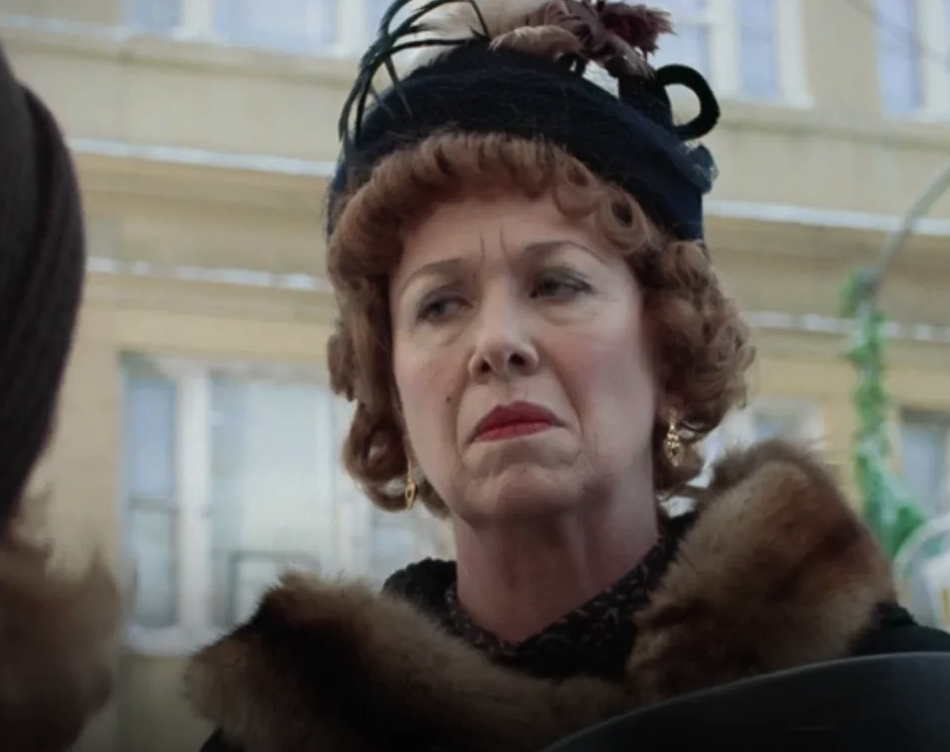
Mrs. Deagle’s stinginess sets the film up as a modern version of “A Christmas Carol.” Like that story, Gremlins can be read as either a progressive critique of capitalism or a conservative affirmation of traditional values. This is probably the byproduct of the collaboration between Joe Dante and Steven Spielberg. The film’s director, Dante, who previously made counterculture films such as Piranha (1978) and The Howling (1981), got in as much subversive material as he could while satisfying producer Spielberg’s demand for sentimentality and commercial appeal.
J. Hoberman sees this relationship in Gremlins as “equally…the triumph of Spielbergism and its antithesis” Citing David Chute, he calls the gremlins “monsters from E.T.’s id.” [4] But of course, even though the film can be seen as “sugar laced with strychnine,” Spielbergism prevails, and the film is generally received as a smooth commercial product, not only providing wide appeal to viewers but, because of Spielberg’s insistence on a happy ending for the adorable Gizmo, selling tons of merchandise.
Gremlins’ Christmas setting maximizes the treacly schmaltz that Spielberg so covets, but it also provides many opportunities for satire. Walking Kate home in the snow, Billy is shocked that his would-be girlfriend is sad on Christmas. In a tone devoid of irony he says, “I thought everybody was happy during the holidays….What’s not to like? It’s a lot of fun!”
Later, Kate’s revelation of the reason for her holiday depression is both horrific and bleakly comic. Her father died when delivering gifts to his family by falling down the chimney and breaking his neck. Kate ends her bathetic monologue recounting that fateful night with the dryly humorous punchline, “And that’s how I found out there was no Santa Claus.” When the Warner Bros. execs previewed Gremlins, they tried to get this speech removed, but Dante fought to keep it in. Aside from the film’s graphic violence, it’s these moments of barbed satire that compelled the MPA to begin giving dark children’s movies PG-13 ratings.
Sentimentality about “the angel of the household” and her place in the kitchen is also dual edged in the film. Billy’s mother is introduced to viewers in the kitchen, greeting her son with homey cheer. When he enters her domain, she is dressed in an apron, comfortingly dicing onions while watching It’s a Wonderful Life on TV. But soon, the smooth, feminine, fifties style kitchen is exposed as a place of chaos. When Mrs. Peltzer asks Billy to help her by making the eggs, he becomes nervous as he approaches one of his father’s inventions. Inevitably, when he uses the patriarch’s egg cracker or orange juice squeezer, the kitchen ends up in a gooey mess that prefigures the blood and guts of gremlins which will eventually pollute every inch of the room’s counter-space and floor.
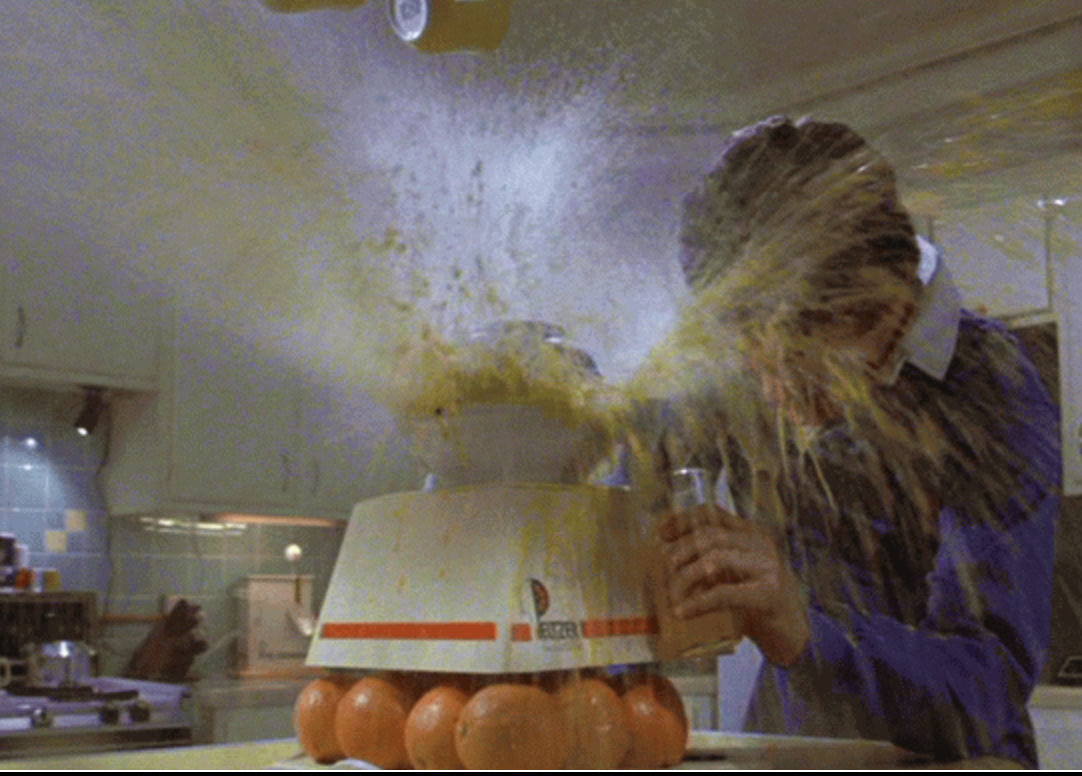
The Peltzer kitchen, then, only seems to exemplify the 1980s conservative revolution that repudiated working women and single mothers while imagining a return to heteronormative 1950s innocence. In the end, this kitchen can’t conceal that the 1980s fantasy of economic prosperity and a happy, patriarchal, white family, masks downward mobility and a fraying division between public and private realms.
In this unruly kitchen, Mrs. Peltzer does her best to maintain “feminine” domestic order, but Mr. Peltzer’s chaotic energy—in the form of his worse-than-useless domestic inventions—constantly intrudes. With the unemployed Mr. Peltzer shut out of public life, he seeks compensatory masculinity in entrepreneurial success. However, rather than a wage, this leads to his hostile takeover of the family’s kitchen. If Mrs. Peltzer were to reject his “contributions” aimed at modernizing the kitchen, she would be pointing out his precarity and emasculation. So instead, she must incorporate these misfiring appliances into her housework, leading to constant bedlam. As Marc Olivier puts it, “No one needs a gremlin to understand the futility of Mr. Peltzer’s inventions, which are, like Kingston Falls, already broken before the little devils spawn.” [5]
The Peltzer kitchen, then, literalizes Laura Scott Holliday’s argument that “the kitchen is a terrain on which boundary disputes are waged over core American values.” [6] Not only does the Peltzer kitchen expose the flawed attempt to re-traditionalize women in an era bereft of a male wage (which had its own definite problems), but it shows that, in a moment of universal privatization, men displaced from the public sphere are now vying for “feminine” domestic spaces even as they try to embrace the ideal of separate gendered spheres. As Vivian Sobchack puts it, the family no longer serves “as a place of refuge from… social upheavals” but rather has become the site of this mayhem. [7]
Just as Mr. Peltzer can’t fake the role of provider, Mrs. Peltzer can’t fully embody the idealized woman associated with a kitchen that comes to stand for “feminity; motherhood; nurturing; domestic life; organicism; literal and moral cleanliness; and innocent, emotional and corporeal, but not sexual, pleasure.” [8] She tries her best, toiling cheerfully over gingerbread cookies on Christmas Eve in her nostalgic kitchen with its clean formica counters and flowery curtains. However, neither she nor her husband can fully embark on what Kristen Ross calls the “flight from history” by way of becoming perfect consumers. For that, they would need money. [9]
Forced to imagine his condemnation to the private sphere as an opportunity, Mr. Peltzer is ironically incapable of protecting his family or sensing danger. He is an example of what Marina Vishmidt and Melanie Gilligan call entrepreneurial “self-motivated subjecthood,” which has become so prevalent in our debt-ridden and gigified moment. [10] Immersed in this logic, Mr. Peltzer rigorously embraces “entrepreneurial drive, self-possession, and hard work” while repressing any acknowledgement or resentment of systemic immiseration. [11]
All this is done to protect Mr. Peltzer’s family, but it only makes them more vulnerable. When Billy explains to him that the mogwais are multiplying and might pose a threat, he can only see them as opportunities for profit—“I’ll bet every kid in America will want one. They might even replace dogs.” He also leaves his house endangered on Christmas Eve to attend an inventors’ convention, which everyone in his family—perhaps even Mr. Peltzer himself— knows will be fruitless.
Thus abandoned, Mrs. Peltzer no longer has to play the perfect housewife. When the gremlins hatch and begin to cause pandemonium, she can finally acknowledge the repression and chaos of her life, rather than constantly tidying it up. The gremlins are not her enemies, but scapegoats onto which she can release her repressed fury.
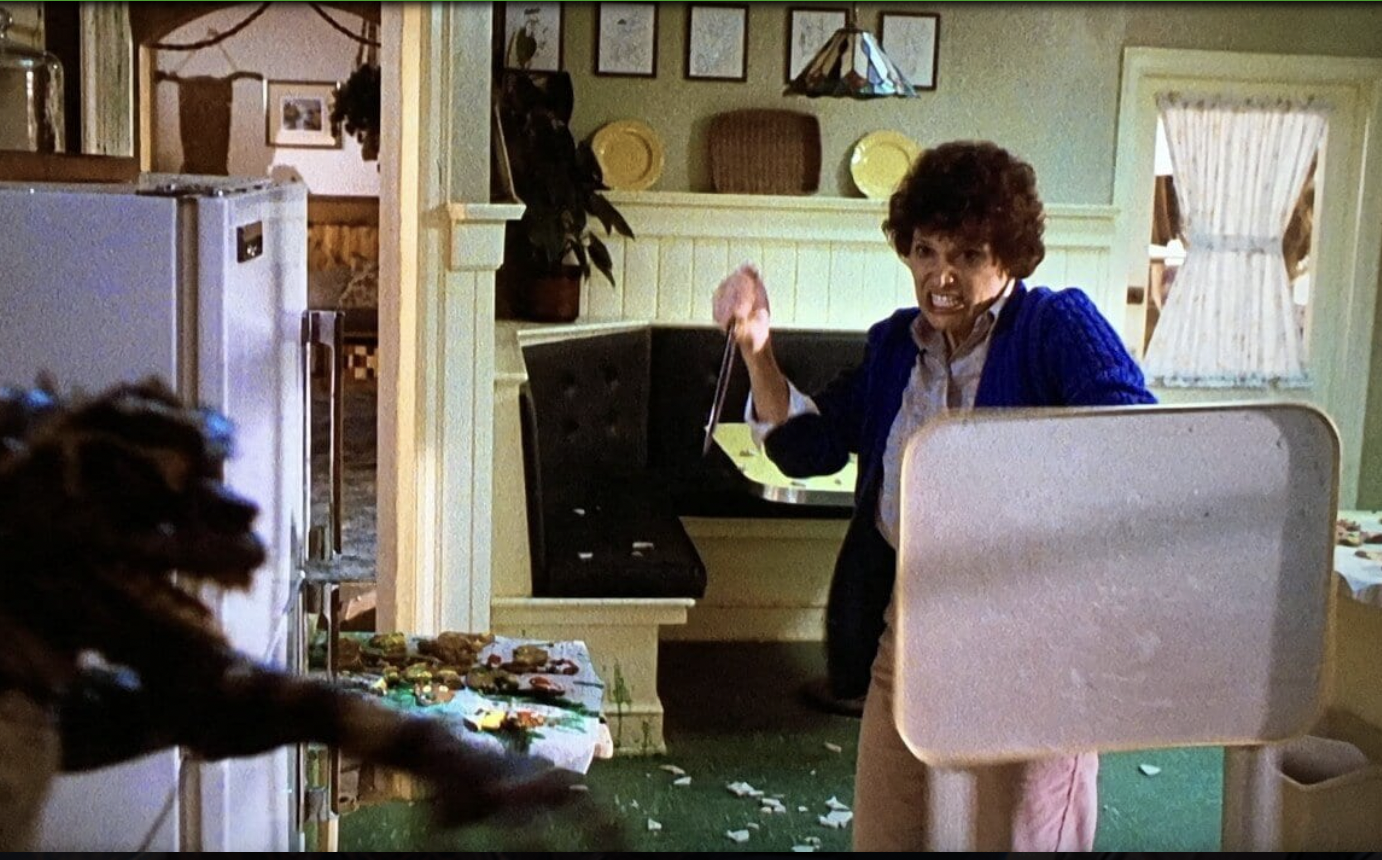
It is this, the film’s most well-known scene, that is also its most subversive moment. When Mrs. Peltzer attacks the gremlins they have not yet hurt anyone. In fact, she might even be enjoying watching them breaking her dishes one by one (no more washing up!) As the Horror Vanguard folks pronounce, “If the gremlins were to gain class consciousness, they would have been unstoppable.” Yet, instead helping the gremlins attack the source of her servitude, Mrs. Peltzer kills the little monsters in the goriest ways possible. After backing one into the microwave, she pitilessly watches it rotate until it explodes, never flinching. In this moment, we can read the film as an indictment of a nuclear family that willfully ignores structural inequity, and displaces anger onto the monstrous “other.”
At the same time, we can see the scene as a housewife’s revenge on tedious and unremunerated reproductive labor. The Peltzer microwave demonstrates what Ruth Cowan calls the “irony of household technology.” [12] Such appliances were never aimed at lessening the housewife’s workload, but rather served the needs of men and of capitalist production as a whole. “The industrialization of the home,” then, protected rather than threatened the separation of gendered spheres, augmenting technology in order to increase consumerism and productivity rather than liberate women.
The grotesque explosion of a gremlin in the Peltzers’ microwave was especially significant in discussions of the film. Roger Ebert started his negative review with a moral panicky warning that it might cause people to microwave their pets— “I had the queasy feeling that before long we’d be reading newspaper articles about kids who went home and tried the same thing with the family cat.” [13] But the urban legend of the pet/baby in the microwave had already been around for years before Gremlins was first released.
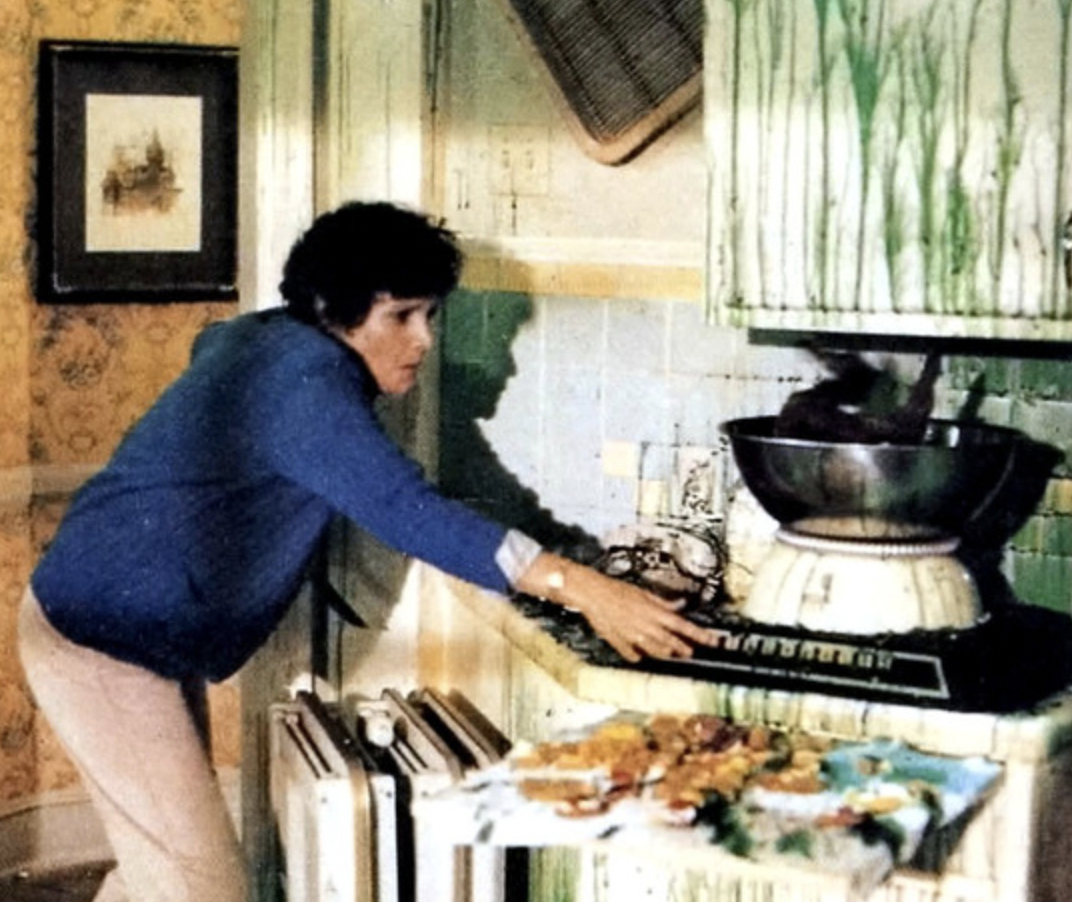
Even before the idyllic 1950s-styled kitchen is destroyed, the appearance of a microwave polluted it with a whole set of discordant associations. In his analysis of this appliance as “household horror” in Gremlins, Marc Olivier calls the it “a gremlin sized chamber of atmospheric terror rooted in wartime research, embroiled in spy scandals and health scares” as well as “tabloid stories and urban legends,” such as “The Baby-Roast” also known as “The Cooked Baby” or “The Hippy Babysitter.” [14] Even if these tales are all untrue, the microwave is a futuristic emblem of technology, domesticity, and cruelty that clashes with the Peltzer kitchen’s nostalgic veneer.
Olivier notes that Mrs. Peltzer’s use of flea and tick killer to terrorize a gremlin before “nuking” it “connects wartime atmoterror to household products and appliances.” In the end, gremlins don’t just destroy the kitchen, but demonstrate domestic space’s power to destroy gremlins, “bring[ing] to the foreground the [microwave’s] efficiency as an atmoterror device,” now available to frustrated families as a weapon to attack shadowy “outsiders” while Reaganite economic predation remains unchallenged. [15]
After witnessing their comrades’ guts smeared all over the Peltzer’s kitchen, the gremlins invade the idyllic small town of Kingston Falls. But, as we have seen, their mayhem follows in the wake of debt and gentrification. Just as the gremlins’ ruination of the Peltzer kitchen repeats the destruction of the home wrought by Mr. Peltzer’s entrepreneurial gimmickry, their destruction of Kingston Falls completes Mrs. Deagle’s program of dismantlement. With a twist of perspective, we can see the gremlins as victims and even heroes as they make the town unusable not only for its inhabitants, but for capital as well. This gleeful insurrectionary spree is thwarted by the film’s true reactionaries—the Peltzers and the “cuddly counter-revolutionary” Gizmo.
This gremlin-as-hero-theory is supported by the otherwise irrelevant character Mr. Futterman who blames everything bad that happens to him on foreigners. By conflating the gremlins with non-US influences, Futterman ventriloquizes nationalist racism of the 1980s, when auto workers displaced their anger at deindustrialization and economic immiseration onto Japanese-made cars, and by extension, Asian people. “Buy American” campaigns turned to white vigilantism as this escalated from slurs such as Congressman John Dingell blaming “little yellow men” for US economic suffering to the racist murder of Chinese American Vincent Chin in Detroit, for which the perpetrator served no jail time. [16]
This anti-Asian subtext is hedged as the film resolves with Mr. Wing taking Gizmo back from the family. On the one hand, he is the man who introduced the “foreign” mogwai into society, further suggesting a racist thread in the film. In the end, though, the film offers a more benign orientalization of Mr. Wing as he comes to stand as the voice of balance and nature. The Peltzer family, like settler capitalist society in general, has squandered “nature’s gifts.”
Despite this slight critique, Gremlins terminates in Spielbergian sentimentality as the gremlins are demolished and the family is restored. Still, the question that concerns me—what happened to the Peltzers’ kitchen?—is never resolved. During the film’s dénouement Mrs. Peltzer offers to fetch some chicken soup, but we never actually see the rehabilitated kitchen where so many of the film’s early domestic scenes are set.
We are left, then, with the image of the post-battle kitchen, where gremlin-innards coat the refrigerator, mixer, and telephone while the ruins of fallen gingerbread men are strewn across the remaining surface space. In its final frame, this kitchen provides background to Mrs. Peltzer, no longer toiling over tearful onions, but wielding the cooking knife with murderous intent.
Author bio: Johanna Isaacson writes academic and popular pieces on horror and politics. She is a professor of English at Modesto Junior College and an editor of Horror Studies and Blind Field Journal. She is the author of Stepford Daughters: Weapons for Feminists in Contemporary Horror (2022) from Common Notions Press and What Ever Happened to Baby Jane? (2025) from Die Die Books. Her book Sisters is forthcoming from Bloomsbury. She runs the Facebook group, Anti-capitalist feminists who like horror films
[1] Ash and John, “Gremlins Review!” Horror Vanguard, https://soundcloud.com/user-317910500/horror-vanguard-lacanian-mogwai-mayhem, Apple Podcasts
[2] Ngai, Sianne. Theory of the Gimmick: Aesthetic Judgement and Capitalist Form. Belknap Press, 2022. 4-5.
[3] Hoberman, J. Make My Day: Movie Culture in the Age of Reagan. The New press, 2019, 202.
[4] Hoberman 202.
[5] Olivier, Mark. Household Horror: Cinematic Fear and the Secret Life of Everyday Objects. Indiana University Press, 2020. 41.
[6] Holliday, Laura Scott, The Frying Pan and the Fire: Gendered citizenship and the American kitchen from the post-war era to the family values campaign, Dissertation, University of California, Santa Barbara, 2000. 5.
[7] Sobchack, Vivian. “Bringing it All Back Home: Family Economy and Generic Exchange” The Dread of Difference: Gender and the Horror Film, edited by Barry Keith Grant, University of Texas Press, 2015. 174.
[8] Holliday 6.
[9] Ross, Kristin. Fast Cars, Clean Bodies: Decolonization and the Reordering of French Culture. The MIT Press, 1996. 108.
[10] Gilligan, Melanie and Marina Vishmidt. “The Property-less Sensorium”: Following the Subject in Crisis Times.” South Atlantic Quarterly, vol. 114, no. 3, 2015, pp. 611–630. 612.
[11] Gilligan and Vishmidt 616.
[12] Cowan, Ruth Schwartz. More Work for Mother: The Ironies of Household Technology from The Open Hearth to the Microwave. Basic Books, 1985.
[13] Olivier 29.
[14] Olivier 39.
[15] Olivier 30;35;41.
[16] Darden, Joe T. and Richard W. Thomas. Detroit: Race Riots, Racial Conflicts, and Efforts to Bridge the Racial Divide. Michigan State University Press, 2013. 165.
 blindfieldjournal.com