
By Johanna Isaacson
I recently completed a book about the 1962 film What Ever Happened to Baby Jane? in which I explore why hagsploitation, an insulting genre to some, inspires my anti-ageist feminism, especially as I enter the unmapped Gen X territory of late middle-age. My attraction to hagsploitation is its privileging of fun and camp over dour portrayals of tragic aging. Coralie Fargeat’s glorious new film, The Substance, runs with this sensibility. Despite its focus on the terrors women face when aging, the film also offers the viewer a celebration of the old lady’s revolting power.
In The Substance Demi Moore plays Elisabeth Sparkle, an actress who once earned a Hollywood star for her leading roles, but who has now fallen to earth as a TV aerobics instructor in a show aimed at middle aged women. Like Moore and most actresses, Elisabeth has been dependent on her beautiful body for her career, but no amount of care can preserve this youthful suppleness into old age.
Fired on her fiftieth birthday by her repulsive, chauvinist boss, Harvey (Dennis Quaid), Elisabeth makes a Faustian bargain with a mysterious corporation offering her “The Substance,” a formula that will provide her with a young, beautiful second self. To work properly, each self may be active for seven days while the “other you” remains in stasis. If the two personae don’t trade off within the allotted time frame, body horror follows.
When Elisabeth’s young avatar, Sue, ignores the rules, Elisabeth’s body decays to the point of unrecognizability. Eventually, Elisabeth tries to put an end to these horrors by quitting the program, but The Substance’s work can’t be undone and she finally ends up as an even grosser amalgam of Elisabeth and Sue, called, with the film’s typical subtlety, Monstro Elisasue.
The excesses of The Substance feel new, but in many ways, the film is a continuation of the Grande Dame Guignol subgenre, in which aging actresses play self-referential characters. This genre, along with its “hagsploitation” and “psycho-biddy” accomplices, are seen by many as cruel to their performers and women in general. The only roles available in these films, critics such as Tomasz Fisiak and Billie Walker argue, are grotesque, derogatory, parodic versions of the actresses themselves.
In fact, in the wake of The Substance’s success, The Guardian published an opinion piece not from a single contributor, but from the newspaper as a whole, condemning the film and its subgenre. As I clicked through links in this article, I found connections to writings by TERFs (Trans Exclusionary Radical Feminists) and I believe this is not accidental. For me, hagsploitation lends itself to a particularly queer, non-cis, drag-queen and trans-centric extravagance that can be weaponized to combat ageism. Although many of hagsploitation’s critics are not transphobic, TERFs’ objections to the subgenre are in line with their rigid views that naturalize the gender binary and tether it to biological sex. Contrary to this literalness, The Substance “defamiliarize[s] the image of femininity itself…” as Alexandra Heller-Nicholas compellingly argues.
In the tradition of Bette Davis, Joan Crawford, and Gloria Swanson’s performances in All About Eve (1950), Sunset Boulevard (1950), and What Ever Happened to Baby Jane? (1962), The Substance’s casting of Demi Moore, a star whose body and age have been widely discussed for decades, shows the entertainment industry’s complicity in ageism, but also allows for a self-reflexive look at the actress herself. The Substance may be read as a sort of worker’s inquiry for Moore, who now relives the scrutiny she has always struggled under, but is finally in control of the narrative.
Gonzo comic excess is key to The Substance’s success, but as hosts Kayte and Mae note in a delightful conversation we had on the Tender Subject podcast, the film’s poignant moments anchor this zaniness, giving heft to the wildness that ensues. The emotional core of the film is a scene where Elisabeth attempts to prepare for a date, but is frozen in her tracks by her own distorted image, a moment so cutting that Alexandra Heller-Nicholas views it as a documentary-like depiction of aging’s unspeakable horrors. As Elisabeth dresses and redresses, violently wiping makeup off and reapplying it, the terror of aging closes in claustrophobically, becoming a form of solitary confinement. All the layers of Moore’s star text and acting skills are folded into this scene. As Anne Morey argues, Grande Dame Guignol gives stars the chance to “dramatize the problems of female celebrity at the same time that they allow them to display their own talents as performers.”

The Grande Dame Guignol genre is in the tradition of Parisian “Theater du Grand-guignol,” a “theater of suffering” that featured outrageous body horror, including “ripped skin, gouged eyeballs, burning flesh, beheading, mutilation, acid-burning, dismemberment, and other psychological distress,” as Peter Shelley describes. Although these films emerged in the sixties and seventies, the body horror promised by the genre has rarely been fulfilled until recently with films such as Drag Me to Hell (2009), The Taking of Deborah Logan (2014), X (2022), and now The Substance. In these films old ladies do not only experience the gothic, psychological terrors that characterized Baby Jane and its followers, they also exhibit corporeal monstrosity.
This focus on body horror in contemporary woman-driven horror films allows uncensored exploration of internalized ageism as well as the creation of vengeful, psycho-biddy monsters that exceed every boundary of good taste. Xavier Aldana Reyes defines body horror as a cultural representation of fear, anxiety and disgust inspired by corporeality. Despite the repulsion they cause, these bodily excesses may translate to empathy, in which “the reader/viewer can be emotionally aligned with the victim and thus fictionally partake of their vulnerability.”
Body horror connects strongly with Julia Kristeva’s formulation of abjection, which links corporeal disgust to those people or elements that are socially or psychically cast-off. Barbara Creed explicitly ties Kristeva’s framing of abjection to horror films with the concept of “the Monstrous-Feminine,” that is, horror’s entities whose terror and degradation are explicitly related to their “feminine” qualities, such as menstruation, childbirth, polluting fluids, excessive emotion, or so-called hysteria.
The Substance’s director Coralie Fargeat belongs to what Creed has recently called a new wave of feminist horror cinema auteurs who explicitly mobilize the “Monstrous-Feminine” to rebellious ends. In these films, Creed argues, monsters like Elisabeth, Sue, and Monstro Elisasue are forced to enter into a “dark night of abjection” and wrestle with patriarchy itself. These creatures’ horrific appearances represent liberation, transformation, and critical insight that come from harnessing the power of “otherness,” as well as the potential for revolt.
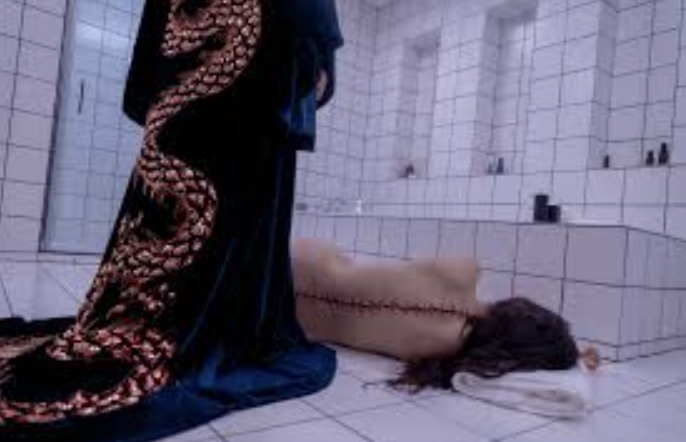
For Payton Mcarty-Simas, Fargeat, a French director, fits into this new wave as a continuation of the new French Extremity of the early aughts that has oozed into woman-driven horror of the current moment such as Arkasha Stevenson’s The First Omen (2024) and Rose Glass’s Love Lies Bleeding (2024). As Alicia Kozma argues, these films bring on “an encounter between the ordered subjective…and unordered threat.” With this confrontation, the monstrous-feminine challenges unspoken boundaries such as that between women considered “young enough” and women for whom “at fifty it stops,” as Harvey callously informs Elisabeth when firing her.
We saw this abject transgression in Fargeat’s previous rape-revenge film, Revenge (2017), in which Jennifer, a beautiful young woman who seems to exist to tantalize the male gaze, is transformed into a bloody, bruised, and torn warrior. As Kozma notes, Jennifer is typical of characters in woman-directed new French extremity films, in which women “are active agents in their own knowledge building projects, controlling their own violent investigation into enlightenment…” This results not in a final recontainment of the monstrous-feminine, as in traditional horror movies, but in an embrace of the abject and unbounded.
Many of the statements Fargeat has made about Revenge could be applied to The Substance. Both films depict the figurative death of a beautiful woman, followed by her rebirth as a vengeful “monster.” And in both, this transformation can be seen as a liberation not only from the male gaze, but from social strictures altogether. Creed sees this deconstruction and reconstruction of the protagonist of Revenge as part of the film’s metacommentary on rape-revenge cinema. Similarly, we can read The Substance as a forceful restaging of the ambivalent psycho-biddy subgenre, further unleashing its liberatory potential.
The Substance follows Reyes’ assertion that graphic body horror has the power to denounce “traditional expectations of the appropriate behaviours of women,” especially in a moment where the culture accepts the monster as sympathetic rebel. Arguably, as Elisabeth transforms into a mottled, withered, ossified version of the monstrous-feminine, losing what is left of her substantive beauty, she gains power. Her physical transformation is not simply degradation but refusal, as she takes on the countenance of a mythic witch and begins concocting toxic, messy brews while issuing curses at fascistic beauty standards.
This witchy section of the film is galvanized by Elisabeth’s appropriation of an insulting gift that she was given upon her forced retirement. Harvey’s final blow after firing Elisabeth was to hand her a package lazily wrapped in Christmas paper. Months later, bored and alone, she unwraps the present to find it is a French cuisine cookbook. Finally launching herself from her torpor, she cooks every dish in its pages, each of which is fatally rich and impossibly disgusting. We are treated to her obscene handling of raw meat as she frenziedly prepares a hideous feast, which she will later single-handedly devour. This scene appears to be Elisabeth’s lowest point, but abjection always contains a seed of liberation and may even build to what Elke Krasny calls “hysterical activism.” As she puts it, “claiming, reclaiming, appropriating, enacting, and performing hysteria can be understood as acts of feminism…”
Before her period of involuntary retirement, Elisabeth clearly starved herself, managing to embody conventional beauty standards past her “prime.” Now, she gives herself to witchy indulgence, “living deliciously,” and conjuring what Erin Harrington calls the “abject barren,” in which detachment from societal expectations leads to perverse, subversive fecundity. Here, Elisabeth literally emerges from her own body as a monster with the power to disrupt the male gaze and the media entertainment spectacle at once.
In depicting this rebellion, Fargeat could have taken herself overly-seriously, but instead she fully gives herself to the excesses of the exploitation genre. As most commentators note, there is nothing subtle about The Substance—it’s lurid, trashy, titillating, and disgusting. The film inherits its desecration of stereotypical femininity from a secret history of feminist-coded hagsploitation trash— The Wasp Woman (1959), The Leech Woman (1960), What Ever Happened to Baby Jane? (1962), Hush…Hush, Sweet Charlotte (1964), Strait-Jacket (1964), Die! Die! My Darling (1965), Beserk! (1967), What Ever Happened to Aunt Alice? (1969), Whoever Slew Auntie Roo? (1971), Killer Nun (1979), Mother’s Day (1980), Butcher, Baker, Nightmare Maker (1981). I could go on for quite a while.
The Substance fuses this tradition with loving homages to an array of films— King Kong (1933), Sunset Boulevard (1950), All About Eve (1950), Psycho (1960), Carrie (1976), The Brood (1979), The Shining (1980), The Elephant Man (1980), and on. I’m especially fascinated with the similarities between The Substance and the schlocky, hyper-comedic, eat-the-rich-body-horror of the eighties, such as The Toxic Avenger (1984), Re-Animator (1985), The Stuff (1985), and Society (1989). What these films have in common with The Substance is an unapologetic anti-subtextual stance. Here, political allegory is so stark that it becomes impossible to analyze with any depth. In these eighties’ films the medium—a spray of obviously fake blood, a chaotic explosion of grotesque prosthetics—is the message. And what is that message? Jouissance, anarchic and collective world-building, the DIY ethos of a punk David up against a Reaganite Goliath.
The Substance’s brilliant practical effects, that have to be seen to believed, continue this tradition. However, what these eighties’ films don’t share with The Substance are its feminist themes. The Substance takes joyous revenge on the male domination of body horror, not by rejecting the mad pleasures of exploitation but by gleefully claiming them as one’s own for the taking. What ecstasy to make and watch a movie that boldly says to its viewer, yes of course ageism, tyrannical beauty standards, the hollowness of online life are ubiquitous. Of course these things are killing me, driving me to madness, dissolving me into a puddle. There’s no need to explain any of this. Instead, I want you to feel it.

While at first it appears that, through her flawless beauty, the younger version of Elisabeth, Sue, escapes the conditions that provoke this rage, she can’t evade the body horror that plagues women at all stages of life. This is made clear in a scene where she is “pumping it up” on her aerobics show, performing a booty-centric dance. With Fargeat’s signature meta-male-gaze perspective, the camera lingers on Sue’s curves when suddenly a large round protrusion pulses out from her butt. Alarmed, a gaggle of male producers appear on set to watch hugely projected footage in slow-motion that captures this eruption. Sue escapes to the bathroom and ultimately reaches in her belly button to pull out the culprit, a gnawed chicken leg that is a remnant of Elisabeth’s binge eating. In the end, we don’t know if this is a fantasy or reality, but it does point to the eating disorders and body dysmorphia that plague even seemingly “perfect” young women.

In fact, in the final show-down between Sue and Elisabeth, it is Sue who is depicted as a monster. When Elisabeth finally, too late, decides to end the Substance experiment, she injects Sue with the antidote, killing off her supple doppelganger. But before she can complete her task, she glimpses a bouquet that Sue received in anticipation of her New Year’s party appearance with a card that reads “They are going to love you.” Seeing this, the unloved Elisabeth loses her resolve and attempts to bring Sue back to life by re-using part of the discarded Substance apparatus. Initially this seems to work, but when Sue realizes Elisabeth’s betrayal she attacks her would-be assassin in an epic fight scene. During this highly choreographed brawl, hot, young Sue is filmed from low camera angels, making her appear as a towering King Kong, rather than the tiny, perky woman-child we saw in previous scenes.
Having disposed of her rival (that is, the version of herself who is a real person rather than a male fantasy), Sue dons her princess dress and proceeds to her New Year’s appearance at the network. However, before she can make a grand entrance, her body begins to rapidly degrade. As in a common nightmare, Sue’s teeth bloodily detach from her gums and her fingernails loosen. Ultimately, she must retreat to her apartment before she completely falls apart.
Finally understanding the meaning of the phrase found in The Substance instructions, “REMEMBER YOU ARE ONE,” Sue realizes her only option is to link herself back to Elisabeth’s corpse. This non-sanctioned use of The Substance leads to the re-fusion of the two bodies into Monstro Elisasue, a distorted monster reminiscent of the Elephant Man, but with many protruding body parts, including Elisabeth’s screaming face emerging from the planes of Monstro Elisasue’s hunched back.
Undaunted by her transformation, Monstro Elisasue finally begins to value herself for her capabilities rather than her appearance. She carefully prepares for her big night by sticking earrings into patches of skin where ears should be and running her one remaining strand of hair through a straightening iron, burning it off in the process. Not totally satisfied with the results, she pragmatically cuts the face out of a self-portrait from her younger days, placing it over her distorted features.
From there, Monstro Elisasue makes her way into the studio, walking down a long hall decorated with her portrait and with carpeting reminiscent of the passageways in The Shining. There, perhaps referencing the delusion of proto-hagsploitation film Sunset Boulevard, she imagines that she is welcomed and adored by an effusive crowd of admirers. In reality, she walks through a barren hall onto a dark stage, surrounded by conventionally beautiful, topless showgirls as they are ogled by Harvey, a gaggle of elderly white male “shareholders,” and a large audience.
As Dawn Keetley notes, old women in horror provide subversive “shock effects” just by appearing, “rupture[ing] the classical narrative arc that centers and privileges the heterosexual couple and the reproductive family.” Monstro Elisasue’s appearance on stage punctures Harvey’s outsized sense of entitlement. He boasts that Sue is his “creation,” but moments later Harvey and his cronies are humiliatingly soaked in her blood. Many will note that the character is a reference to Harvey Weinstein, but as I write this essay two days after the 2024 elections, his resemblance in appearance and behavior to Trump (famous for pawing beauty contestants with a sense of ownership and for dismissing his former sexual assault victims as old and ugly) shouldn’t go unmentioned. If Monstro Elisasue can shut Harvey down, who knows what the hellraising hag is capable of? In our mad times, the psycho-biddy embodies queer refusal. She is a non-toxic avenger standing up to chauvinist, fascist onslaughts.
Insisting on her right to exist, Monstro Elisasue approaches the microphone. “I’m still me,” she insists. But her voice comes out garbled, and the crowd turns on her with ferocity. A man approaches this “monster” and summarily decapitates her, only for her to reveal her new body as a vector for collective retribution, as she sprouts additional heads and her orifices gush forth torrents of blood, dousing the audience in an homage to Carrie’s famous prom scene. Notably, unlike Carrie, she is the agent rather than the victim of bloodshed. Here, Monstro Elisasue’s anger has germinated into insurrectionary violence, showing The Substance to be more than a grotesque portrait of internalized ageism. It is that, but it is also a tale of ecstatic metamorphosis in which the pain of rejection is transformed into spectacular revenge.
Author bio: Johanna Isaacson writes academic and popular pieces on horror and politics. She is a professor of English at Modesto Junior College and an editor of Horror Studies and Blind Field Journal. She is the author of Stepford Daughters: Weapons for Feminists in Contemporary Horror (2022) from Common Notions Press and What Ever Happened to Baby Jane? (2025) from Die Die Books. Her book Sisters is forthcoming from Bloomsbury. She runs the Facebook group, Anti-capitalist feminists who like horror films
 blindfieldjournal.com
thank you for the article. I enjoyed reading it immediately after finishing The Substance. Alone, in my living room at 2am as a queer trans person. There is no way I could have possibly put all my thoughts about the film to paper, but you did a spectacular job of it.
LikeLiked by 1 person
Thanks so much for your feedback. You made my day!
LikeLike
fab writing on this film!
LikeLike