By Jacob Potash
A funny thing about the Internet is the way it renders one’s sense of place outmoded. And in doing so, it pulls the rug out from memory. “Where were you when you found out…?” the question begins. Information we’re obliged to know is hung on the rack of where we are: I was in my kindergarten classroom when the towers fell. But to go online is to be everywhere, and what John Ashbery said of time is true of digital space. “All time / Reduces to no special time,” and on the ocean of virtuality, everyone is a castaway.
I don’t know where I was when I became aware that my brother had a Twitter account; or that he used it with an unusual avidity; or that his posts got a lot of “engagement”; or that he was becoming (to think!) a minor celebrity. His considerable fame, among the young and left-leaning in America, has never felt quite real to me. His name, like so much else in our lives—bottomless puff-pastries of digital representation, subsidized webs of invisible influence—has seemed to me to be visible nowhere and everywhere, like something out of a paranoid dream.
Sometime in the last few years I began regularly to get texts from somebody or other who’d seen a tweet of his retweeted, or reposted to Instagram. Those faint attempts at communication only ever half-registered in memory: the iMessage notifications and stories and trending topics existed to me on a secondary plane, the coordinates of which did not match up with those of that terribly memorable thing, reality. Maybe this is what it means to be famous online: to be forgotten.
* **
I was at the granite kitchen island of my friend’s house in Beverly Hills when his mom, for years head of corporate partnerships at a movie studio, told me she followed my brother on Twitter. She turned to her son:
“It was Janet who told me about him,” she said.
Then, turning back toward me:
“My friend Janet. She says she likes to”—tone and expression shifting, in one of those inscrutable ironies of the rich—“follow radicals online.”
Pushes her blond bob behind her ear and smiles.
“It’s so funny. When I heard your name, I thought it sounded familiar but I didn’t make the connection.”
With hindsight, the question becomes only more pointed: what drew this woman to my brother?
Why, across thousands of miles, are sorority sisters turned marketing executives reading tweets by a high school English teacher turned full-time activist—tuning in to his frequency, where he delivers a nonstop stream of political messaging? The answer says something about our lives—yes, all of our lives—and how they are inevitably mediated and politicized.
To say that my brother is famous is to describe a state of affairs in which his tweets have, in the last month, received over 2,600,000 likes. I have just counted and am shocked by the number: two point six million. I told a girl in broken Spanish six years ago that, weird as it might sound, I didn’t know my brother very well. The word for weird was “raro.” That isn’t raro, she said. My brother and I hardly spoke growing up either. I have only ever been dimly aware of my brother as the person in the next room, who played sports and went to a different school. The time has come to properly ponder my brother. He has gone mega-viral; some introspection is in order.
***
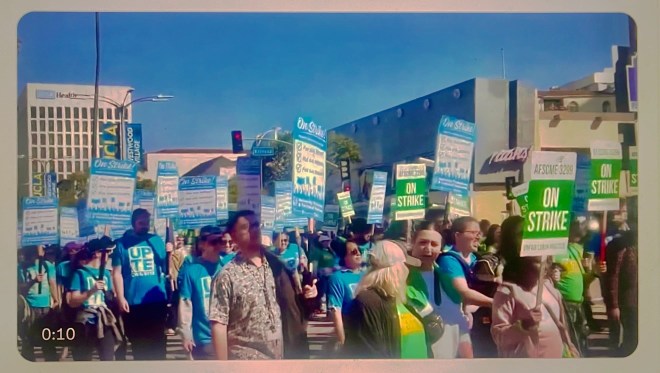
The cause that inspired radicals on Twitter (X, now) and the suits (metaphorical only) on Wilshire Boulevard to find common ground in the years during which my brother gained an online following, was of course the presidency of Donald Trump. From 2017 to 2019, as worry mounted among people with a soft spot for the constitution that Trump would not relinquish power peacefully in the event of electoral defeat, my brother began to post videos of peaceful protests.
With a frequency and consistency that were objectively impressive, he uploaded videos of people marching through the streets, filmed up close or else from drones hundreds of feet in the air. Unbeknownst to me, he had quickly settled on a brand: when I first visited his profile, it already had 20,000 followers.
I noticed, when I visited his page, that it did not matter which streets were home to these protests. It did not matter which politician or government had become the object of collective reproach, or on which continent the marchers lived. Ethan reasoned that the practice of peaceful demonstration as an act of resistance to unjust government was worth encouraging anywhere. Every day brought 30, 50, 100 fresh tweets. Any corner of the globe was liable to find itself in his spotlight.
Ethan’s rationale for culling videos from around the world was clear, at least to him. He wagered that by publicizing videos of marches—getting them to circulate widely on social media—a culture of popular resistance to authoritarianism could be ignited across the world. A thriving protest culture, he told our parents and me, could help inoculate the US against the possibility of unconstitutional, indefinite rule by the bad orange man.
“We need to take to the streets!” came the daily exhortation. Or, “holy shit,” the tweet would declare (profanity was so regular because it proved effective in increasing engagement), “this protest is beautiful!” By “beautiful,” he meant nothing smarmy or Trumpian. This was idealism, gushing and pure. On the one hand, fascism was ascendant. On the other, citizens of the world were uniting against it. They stood, with brave literalness, on the right side of history—and so, by proxy, could you!
***
It seemed to me back then, and still seems, that my brother’s online activity reflected a fairly straightforward left-wing populism. Such a view imagines, romantically or not, that there is a decent but disenfranchised majority who can express their political will through mass demonstrations—and that this, more or less, is the salve for coercive and corrupt regimes the world over.
The view is largely defensible, if a touch Manichaean. One way to fight numbers is with numbers; and in a two-party system, each can help to keep the other in check. But I could never suppress some sliver of skepticism. It was and remains too common to willfully ignore the mirror-effects of right and left—the fact, namely, that right-wing populism engendered and sustains Trump, a populism that rides on the atavistic highs of throngs of people shouting slogans.
Not all problems lend themselves to resolution-via-tweet. So it might be the case that I am making objections that are not intelligible in the world of the platform in question. But the site’s users had objections of their own: they noticed and flagged, early and often, the fact that Ethan did not take all the videos he shared. He would scour his feed for apt clips, then download and repost them without attribution, and with misleading commentary about what they depicted or none at all.
Individual users disgruntled with Ethan’s appropriation of footage slowly kindled something like a backlash. By early pandemic, it was official: he had achieved a level of saturation and visibility on Resistance Twitter sufficient to become a target for widespread criticism and snark. Users, as they are wont to do, called him out.
“Free account idea,” smirked @sportsticks in 2020. “Steal all of Ethan’s videoclips (which he ganks from other people) and replace his generic ‘gee look another protest’ text with something interesting and relevant. Boom! You could have 50K followers in no time!”
Others were more to the point: “Fuck Ethan,” declaimed @commieflage in 2019, “and his kleptomanic tendency to repost ‘protest’ videos to opportunistically peddle & boost color revolution” (a term for uprisings orchestrated by Western powers to promote regime change). Other users descended to ad hominem attacks: “his name,” one wrote, “sounds like another word for mashed potato.” The gatekeeper had come under suspicion. I wondered: were Ethan’s 15 minutes drawing to a close?
***
We were nearby, Ethan and I, for the better part of those years. At first I lived in Brooklyn, while he moved from Harlem, to Astoria, then back to Harlem. Later I lived in Los Angeles.
I can hear the friend’s mom asking, as she pulls bottles of wine out of the refrigerator: “Do you see much of each other?”
“We have lunch every few weeks.”
“Oh! Good.”
Her approval or disapproval was always stark and, as it were, telegraphed. People seemed to crave the former, and tip-toe around the latter. Luckily she had just gotten confirmation of a comforting truth: my brother and I were to some degree normal, easygoing people who enjoyed each other’s company.
We saw each other regularly then—which occasions were surprising for how rarely Ethan mentioned Twitter, tweeting, or even politics. His mood was not as a matter of course militant or edgy. He sounded moderate in his opinions, only somewhat engaged in paying attention to political news in any detail, and on the whole more interested in his friends, work, travel plans, and romantic prospects than in leading or catalyzing demonstrations.
During these years (2017-2020) Ethan grew his beard out, went from skinny college grad to desk-bound professional, wrote a science fiction novel in his spare time, left a teaching job to tutor privately; and then eventually, disease broke loose, and he went to live with my parents while I quarantined out West.
***
Acquaintances of mine who regard themselves as savvy have sometimes made comments—“What is he doing this for? I mean, he would be in a good position to run for political office soon,” or “He’s making himself very useful to a certain political coalition. It’s smart…”—to the effect that they were waiting for Ethan’s grand plan to unfold.
I wonder now if those people weren’t attentive enough friends; or whether they didn’t pick up on a degree of fraternal symmetry—since I am only beginning to see our paths as moving in tandem.
Today I see his flood posts in a soft light. I see them as the manifestation of a bold idealism—an intense, if fledgling, effort at standing forth in the world. At becoming what is called an individual. I see them this way because during those years I wrote a novel, furiously for a few months, then not at all. And I wondered, after finishing, what to do with my incomplete jottings. It was exuberant, the manuscript, if not exactly accomplished as a piece of fiction, and I had little interest in making my writing integral with a professional trajectory or “freelancer portfolio.”
He did it out in the open, while I wrote by hand, sometimes in a closet. But I know why he tweeted. I know why he wrote, because I know why I wrote. I wrote because I wanted to effect a transformation; to call it internal or external would be beside the point. I wrote because there’s pain in the world, some of it mine. I wrote because when you are young you believe in gestures that will have only indirect or negligible effects. I wrote because when you are young, you believe in yourself.
Vantages loom suddenly, and I recall now my parents—who met in West Africa, digging wells with villagers. Whose relationship began on top of a hut, over a joint. My brother, accordingly, spent part of his childhood in the Republic of Benin, where I was conceived. They stood forth, too. They managed to give grandiose shape to their dreams of significance. And today? Today that was all a long time ago. But at least they can be sure 35 years on of having, when they were still young, gone somewhere, been someplace.
***
What does it mean that my brother is famous? Does it mean something about the news cycle, about the attention economy, about the emotionalization of politics or its meme-ification? Should it prompt disquisition on the nature of the image, the baroque overgrowth of the superstructure?
No, I think those are the wrong words for talking about one’s brother.
If you visited Ethan’s page today, you’d find that he no longer posts videos of marches; that his interests have broadened, and that he is asking for your help in dismantling capitalism, decolonizing minds, abolishing ICE and prisons and the police. You would find him denouncing greed, or commenting more favorably on kindness and wealth redistribution.
I do not quarrel with lofty goals—his or anybody else’s. I know that anything can be turned upside down; so that when I look at Ethan I do not see an activist, or an agitant, or even necessarily a moral actor. Instead I make choices. I choose to see a restless young man, a frustrated writer. I see a seeker and a student. I see, all in all, a brother.
***
Motion has been, for many writers, a phenomenon near the mystic core of life. For Emerson the will could only realize itself in transition, in “the shooting of a gulf, the darting to an aim.” John Ashbery warns, in a well-known poem, against abandoning “the beginning, where / we must stay, in motion.”
By 2020 I had wound up in California for the same reason I had left social media: placelessness. I wanted to go somewhere, and subsequently to be someplace. Both felt strangely impossible. I had savings and skills, friends and a good education. But I felt that I had, in a newfangled but real sense, nowhere to go. A week after arrival to California, my sense of immobility was resoundingly confirmed. Lockdowns set in. Our common mind-body parting had been accelerated.
Then, something unexpected happened. A few months into the pandemic, people began to move.
In an eruption of sympathy and willfulness, street protests took over America and the world. Who knows whether people had learned something from those millions of hours of dancing pixels, those images of people traveling through urban landscapes, captured and reproduced to be distributed finally by Ethan? Whether inspired by Ethan or no, people took to the streets—which is not something that can, strictly speaking, happen online. They broke through a depression—physical and psychological, digital and political—and walked through their front doors.
Protesters in Los Angeles know where they were that month. I saw them dancing on traffic islands, waving signs, heaving and yelling and remembering a killing. Eulogizing in the sun. And by protesting they broke through, however briefly, a paralysis—the paralysis of our age, with its frontierless war on embodiment. The paralysis of our nowhere lives.
***
Eventually the riots reached Beverly Hills.
The blond mom asked a police officer over to conduct a security review. She was worried the house could be breached. He recommended putting metal bars on the first-floor windows.
I remember where I was a few weeks later when discussion in the Beverly Hills family grew tense.
“Intergenerational wealth gives people privilege,” the older daughter told her mother with perfect earnestness. “And it insulates them from negative interactions with law enforcement, so that when stuff like this happens, people have really different perceptions.”
The mom tensed her jaw.
“That’s why they’re chanting Eat the Rich,” the daughter continued.
“Well, we can do other things,” the mom offered, “to make the country more prosperous and safe.”
“Like what?”
The daughter was close to the end of her rope.
“Like bringing manufacturing back to this country, building factories here for a change.”
“That,” muttered my friend, “sounds like a certain president’s platform.”
Palo Alto. That’s where I was. We were in the living room area of a small rental house, in a municipality where an untold number of billionaires live in deceptively modest houses. I was in California, with someone I loved.
And you?
“Where were you when you found out…?”
Jacob Potash is a filmmaker who lives in New York.
 blindfieldjournal.com