by Sophie Lewis |
Three years ago, Viola Davis magnificently embodied the eponymous general in director Gina Prince-Bythewood’s blockbuster about a West African all-female warrior unit set in the early nineteenth century: The Woman King (2022). And what director wouldn’t want to capitalize on the triumphal feminist affects inspired by those Dahomey amazons?
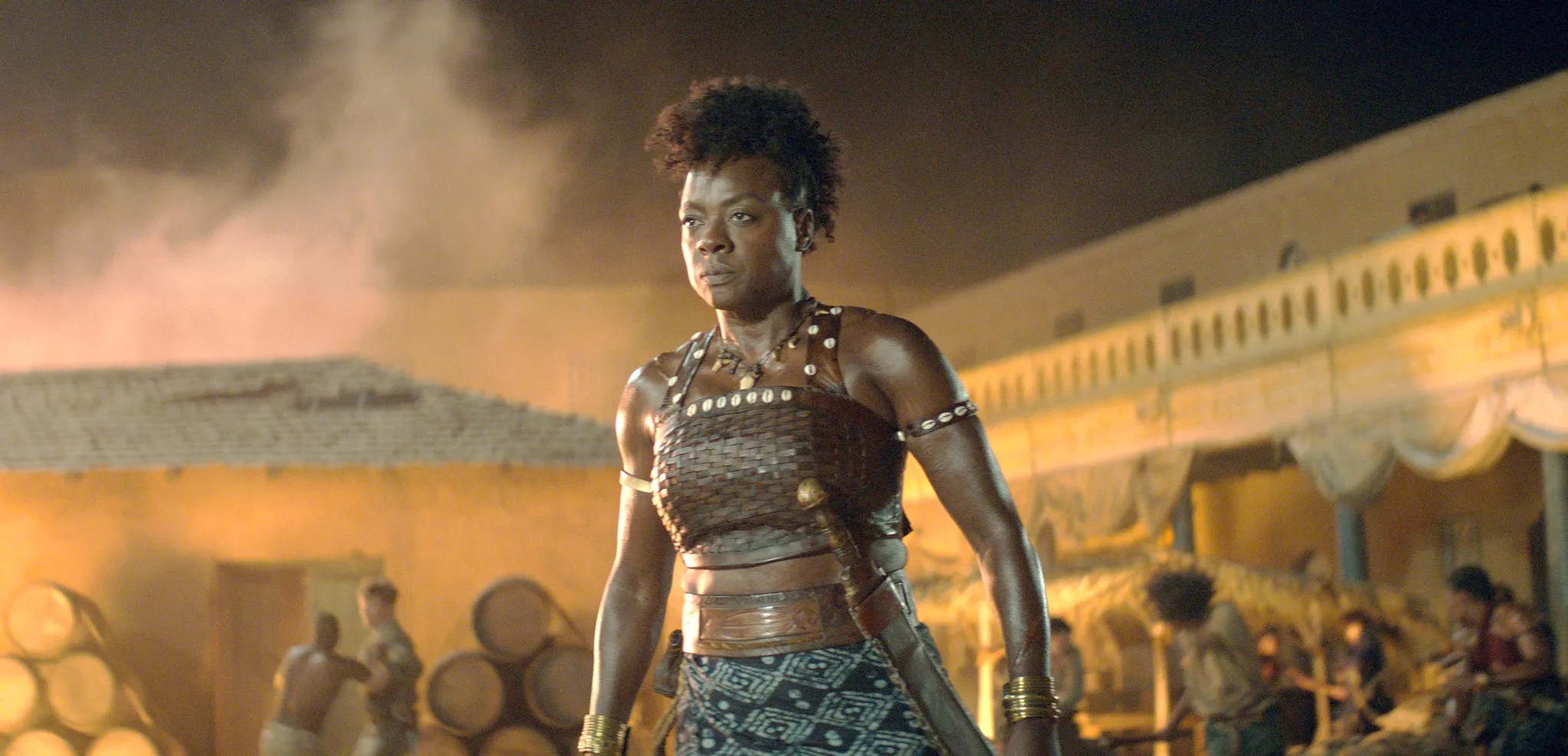
Let her run the G20, am I right?
Promptly, another director of color—Patricia Riggen—cast Davis as the woman king, so to speak, of the United States of America, on Amazon™.
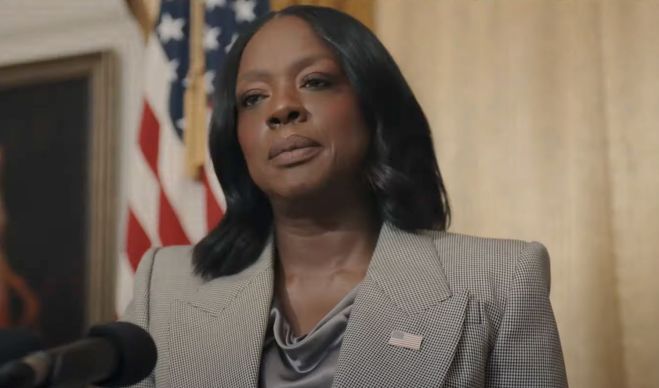
Look, if anyone could make the office of the president look like a force for humanity’s benefit, it’s Davis. But an extra difficulty attendant on that already formidable task is that—whereas Woman King had a clear moral compass, pitting our girl Viola against a tribe of slavers—G20 isn’t remotely convincing about the answer to the question: are fascism and the Oval Office enemies? The palpable uncertainty is a bizarre own-goal flowing straight from the movie’s absurd premise. On its face, things are simple: the feminist, Black-woman-led U.S. wages a lot of imperial-humanitarian war (good) and nobly succeeds at ending world hunger by using bitcoin (good), but meanwhile, a hacker-terrorist cabal mouths leftist- as well as Nazi-coded phrases, takes world leaders hostage, and uses deepfake technology to create videos of them seeming to confess to a nefarious plan to “reset the global monetary system” (bad). The insurgents are carrying out this hijacking in order to “reset the monetary system,” though, for the simple reason that they, too, want the world to switch to cybercash (bad). The dollar, one reporter suggests, is “failing”—but our President disagrees: “Don’t try to hijack my narrative. The dollar is not failing.” Believe women.
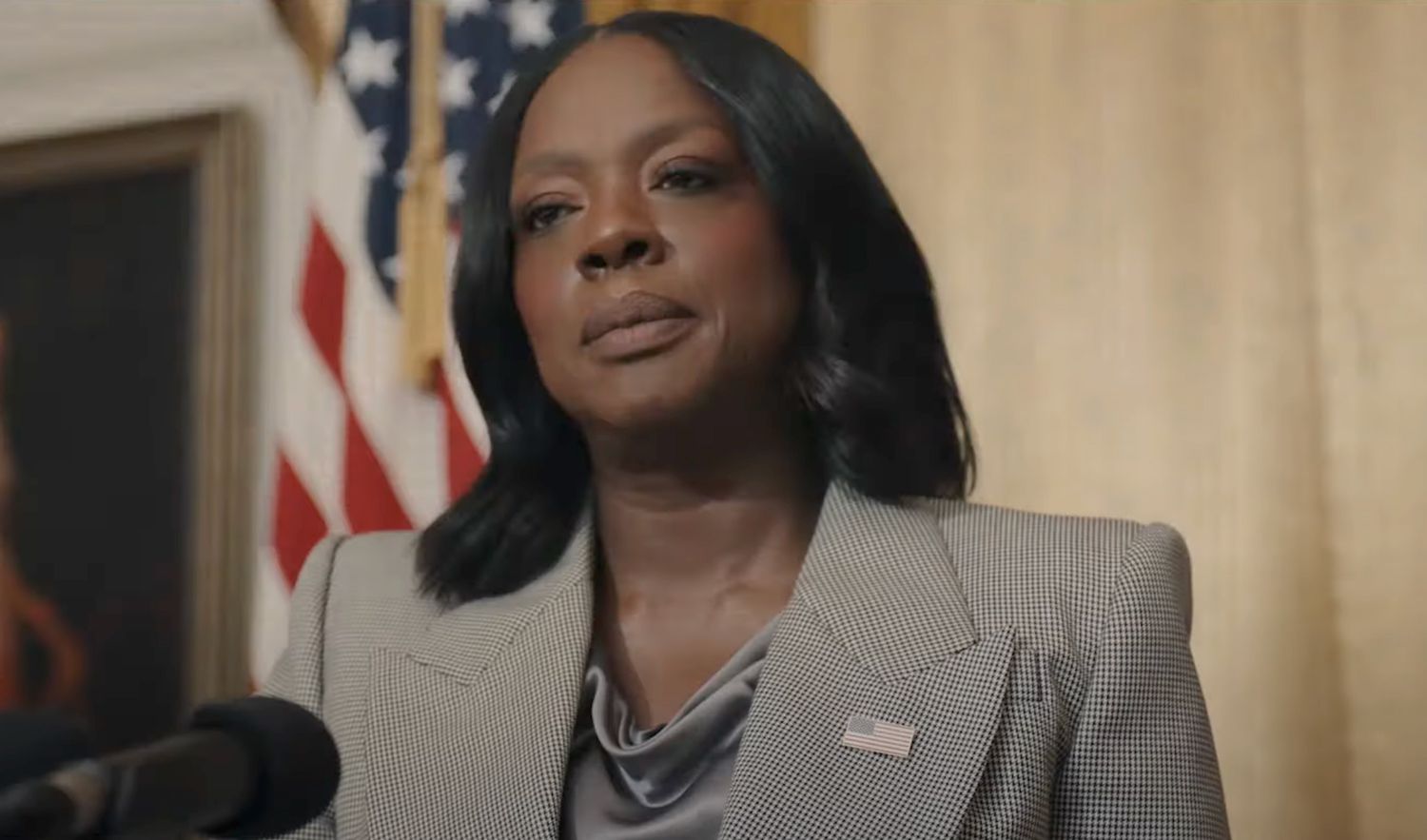
Tfw you wish you were still in the 1820s, leading the Agojie people into war.
Insofar as it is possible to give shape to a void, the Amazon Prime presidential action-adventure also captures the vast blankness at the heart of capitalist antifascism—an attitude summed up in the President (Davis)’s climactic line, addressed to the insurrectionary villain who wants to “change the world”: “You’re not going to change anything, because I won’t let you.” Antifascism, here, means: nothing changes. G20 is a paean to bi-partisan technocracy, dressed up as an epic tale about Mom aka Madam President, the War Hero. When you stream this movie, you’re staring right into the multiracial, femonationalist heart of reactionary liberalism. Davis isn’t playing Trump or Kamala, a Democrat or a Republican—although she is doing both of those things—so much as she’s playing Uncle Sam. It never occurs to the President in this movie to refute or deny the various accusations of “warmongering,” “profiteering,” and “stealing from the poor” that are leveled at the U.S. by the “terrorists” as they set about “stealing” back all the money from the world’s standard currencies. “I chose life and service,” is her only explanation. “Never underestimate a patriot,” teases the poster for this absurd morass of copaganda (prez-aganda?). And this is, actually, helpful. Patriotism, G20’s clearest “message,” tells us the extent to which Amazon doesn’t give a hoot which candidate won the 2024 presidential election. Empire’s simply gonna empire, or so they confidently assume—and if it doesn’t, that’s fine, because the insurgents might also be Amazon™-type people.
And why not? The possibility that there isn’t all that much, morally speaking, that separates the leaders of the free world from the masked men “stealing” the global economy surfaces briefly, when “Rutledge,” the leader of the latter, tells the former group that he is merely one of the gravediggers the system generates for itself: “You created me, you created all of this, with your corrupt wars and your profiteering,” he yells. In order to try to smooth this wrinkle over, one of the elite national representatives cries out: “if we were as guilty as you claim, you would not need deepfakes.” The “facts” alone, as the fantasy goes, would do the trick and start the revolution, if the facts in question were really that explosive. Beyond this, however, the movie doesn’t trouble itself to reconcile the awkwardness: “corrupt” deepfaked speech out of the mouths of the ruling class could only bring down governments if the revelations they deliver were believable, which is to say, true (in a structural, if not specific, sense).
G20 epitomizes, as such, the fascism-midwifing liberal worldview that Andrea Long Chu has recently dubbed “the far center.” Yet actual fascism, just to reiterate, is in this movie in a purely superficial, content-less sense. The G20 fascists are lazily signaled at, rather than depicted; their aims are certainly not to be distinguished from any other insurgent politics. Well, this is clearly good enough for many audiences. The hypermasculinist racist—white South African and Australian—goons who hijack the conference are gamely described as “extreme right wing” in the New York Times’s write up of the movie. It’s true that Rutledge references “The Big Lie”—the Hitlerian phrase that has been adopted by fringe MAGA elements to invoke their loss of the 2020 election, but their anti-war, anti-poverty politics otherwise seems more Wikileaks- or Anonymous-esque. Still, despite positioning these guys as evil, G20 seems to flirt constantly with the dim recognition that racial fascism is the status quo in this plantation-based settler colony known as America. Presumably that is why the thing the “baddies” want to unleash—crypto—is the same as what the “goodies” want in terms of aid policy—“digital currency”!
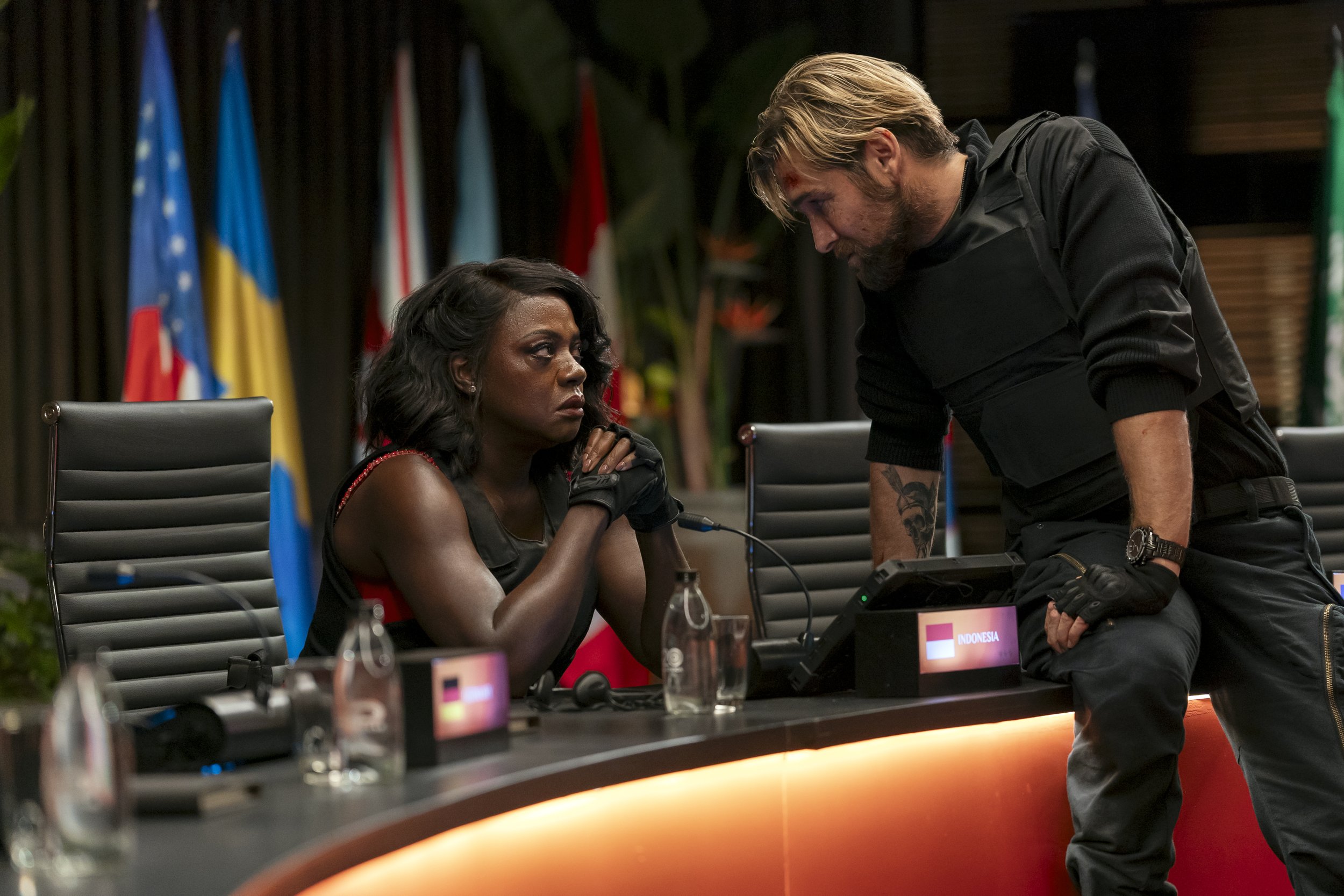
“Yes I am an animal, I am your animal, you made me…”
It is as though the guys at Jeffrey Bezos’s Trump-indulging corporation dimly register, on some level of their consciousness, that they, the crypto bro-liarchs, are the “baddies,” even while telling a story about this world-historic Black female “goodie” who pioneers crypto as a way to feed the hungry, physically fights mercenaries with only her fists and an assault rifle, protects her kids and bodyguard, and does it all while wearing sneakers and a torn-short red satin ballgown. The world needs good crypto, not bad crypto, OK? “Centrist” antifascists are fighting spectral projections of themselves, and on some level, it seems, they know it.
Hot tip: Sophie wrote about all of this in her essay “Lipstick on the Pigs.”
None of this negates the fact that G20 hits the eye as an encomium to the Kamala Harris presidency that wasn’t: a fantasy that Kamala would somehow have fought fascism, even though she consistently poured fuel on its fires, in Gaza and at home. Even though G20 was dreamed up and manufactured well before Kamala announced her presidential campaign, the whole thing (released on 10 April 2025) feels at times like “Momala” fan fic. Candidate Harris was famously California’s “top cop.” The character of “Danielle Sutton”—this new woman-king played by Davis—is a former captain in the U.S. army. Harris, who parents two children (Ella and Cole), learned “how to be a mentor AND a hardass” from her own mother. Sutton, likewise, is a disciplinarian mother of two. On the real life campaign trail, “Kamala Harris ran her office like a prosecutor,” according to the Washington Post. President Sutton—qua avatar for the victorious Kamala—is portrayed as a terror to the White House staff. In fact, Sutton’s first words in the movie are: “I’m going to ruin someone’s day over this.” Her aide replies: “I don’t doubt it, ma’am.” (Being horrible to one’s underlings, as we know, is celebrated when it’s a pantsuited executrix doing it.)

Sure, Joanna, my treasury secretary, called me “a warmonger” in an attack ad during the primary, but we’re still friends.
Everybody reassures Madam POTUS that she is “a good mom.” This is necessary, I assume, to offset the classic line of the in-leaning bossbabe, which comes shortly after the line about ruining someone’s day: “I’ve had to work twice as hard to get here.” This last part is uttered in the context of grounding her 17-year-old, to punish her for attempting a “jailbreak”; the teen, for her part, says she feels caged “like a zoo animal.” (Recall how attorney-general Harris locked people up over truancy and marijuana possession?) The tough-on-crime President even has a liberal, white, Hillary-like cabinet colleague who backstabs her. This is the treasury secretary, Joanna—a self-described “soulless capitalist” and “divorcée”—who ostensibly called Sutton a “warmonger” in an attack ad back “during the primary.” Nonetheless, as Sutton generously muses, “we never stopped being friends,” and at this juncture, Joanna reflects that her criticism of a “war hero[ine]” meant, anyway, kissing the nomination goodbye. Reframing the women’s rivalry in sisterly terms, Sutton draws a shattered glass ceiling under the whole awkward matter: “100 years ago, neither of us could vote, but here we are, you and I, on the way to G20 on Air Force One.” At the end of the movie, however, Joanna gets her comeuppance, snarling that it was she who was entitled to be president, not Sutton. It turns out that she was the “inside man” for the dollar-hating terrorists all along—the accomplice of their stock-market-destroying conspiracy—a fifth column within America.
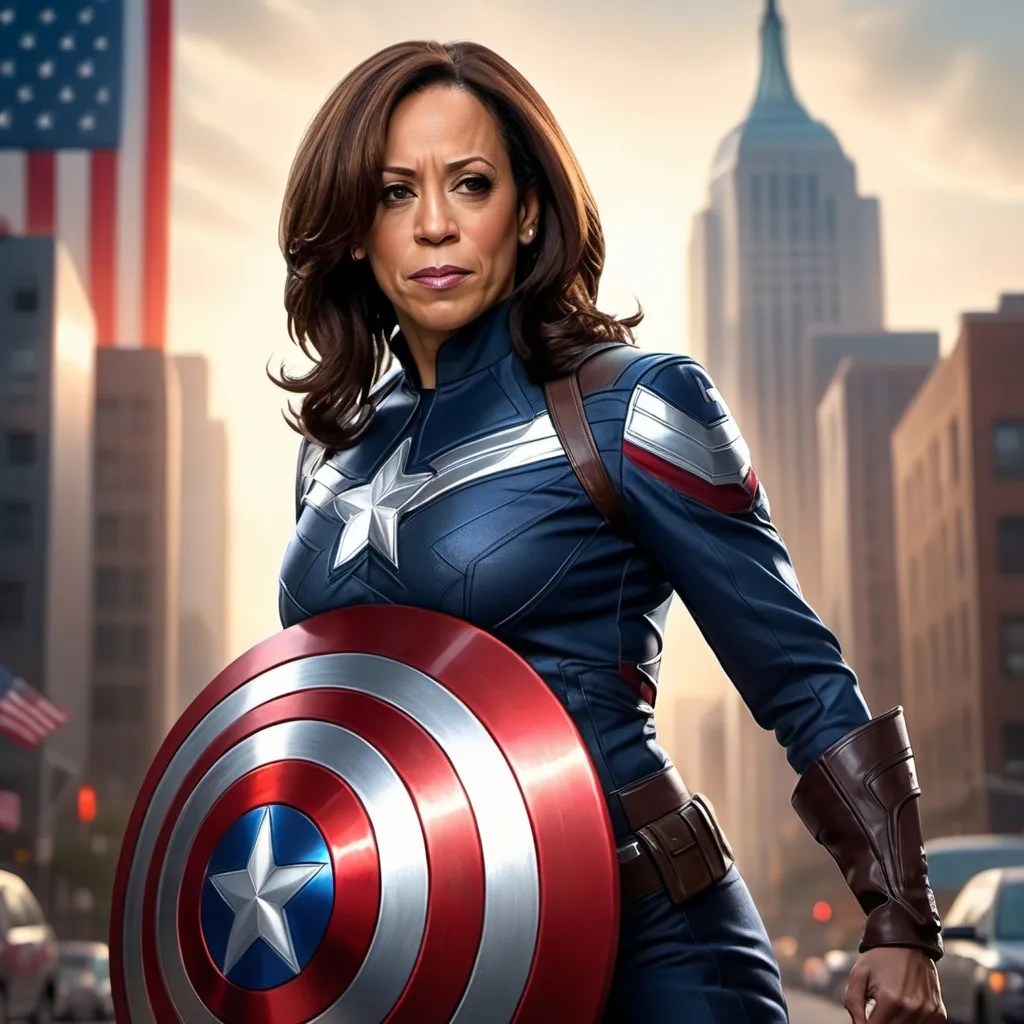
From Hillary-hating to femonationalism, then, there’s really something for everyone in this movie. Especially Marvel Comics fans. The camera pans, early on, past a glossy image of the now-president in combat helmet and fatigues, heroically carrying a small brown child through a war zone on the cover of Time magazine, beneath the headline “Fallujah under siege: battle for the soul of Iraq.” You may remember that Harris was copiously photoshopped into police regalia or Marvel-style body-armor, plus matching American-flag inspired shield, insofar as she was lionized in the liberal imagination as the nation-state’s existential bulwark against a certain orange-hued, felonious symbol of anti-democratic doom. Well… the fictional version points out, in so many words, that she is wearing “a superhero cape,” and announces unironically that she is about to “save the world” with her virtual scheme to help African farmers access credit. Furthermore, the planet’s premier female also has superheroical geopolitical nemeses-turned-allies, such as “the second most powerful woman in the world, after you”—Elena, the white Italian head of the International Monetary Fund. Elena warms to Sutton on the basis of feminist feeling in the midst of the terrorist emergency. “I’d rather leave and be led by her,” she says, referring admiringly to Sutton in the midst of the attempted hostage situation, “than stay and be annoyed by him” (meaning: the dickhead British prime minister). “I’m not as tall and as confident as you,” she then adds directly to Sutton, midway through their escape attempt. This serves to explain why Elena “has to wear” high heels, thus, of course, the plot duly provides the opportunity for Signorina IMF to defiantly remove the high heels, leap behind the wheel of a car, and play her own heroic part in the great military adventure. Emulating the Marvel Studios promise—i.e., the militaristic pleasure of a Manichaean civilizational showdown, for her as well as him—Riggen uses the “inexperienced” (in its words) terrain of South Africa, qua host for the G20, as a sandpit for a scene of Western, woman-led, capitalist world-saving.
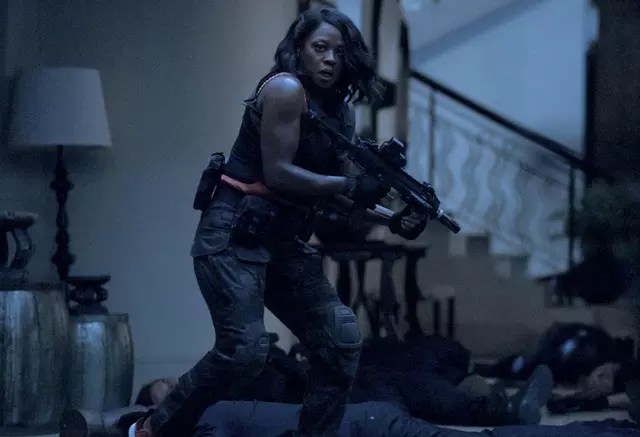
Madam President said she would machine-gun down the terrorists herself.
If feminist microcredit saving the day sounds a bit 2013 to your ears, you are right. But rather than write movies like G20 off as unworthy of critical attention, perhaps we could do worse than to track the “radical” critiques that Hollywood’s mediations of the waning U.S. empire do give air to; to notice how they implode, yet bubble back up, and (especially) what deeper critiques they foreclose. “You carried a child from a blown-up building, and someone snapped a photo,” taunts the fictive leader of the UK, antifeministly, “and now you’re Captain America?” The viewer is supposed to think that this British buffoon is an asshole for saying this. But Sutton is strangely insecure in this conversation, much more so than when she, later, slaps Joanna and booms: “I WAS ELECTED.” Sutton confesses to the asshole that she only saw active combat for a few minutes. But, she tells him, she “had to pry that boy from his mom, who was blown apart.” (Blown apart by whose bombs? asks no one.) Moments later, the awe-struck prime minister’s contrite response compares her to Winston Churchill. (This, I am told, is supposed to constitute a compliment.) There’s no rest for the girlboss, though, and during the movie’s climax, Sutton’s combat credentials are again mocked. This time, it is the leader of the crypto insurrection, who has just revealed that he lost two friends—Australians killed by bombs “meant for Americans” no less—in Fallujah, who spits the following at Sutton: “You plucked a kid out of the rubble that you’d created, you got a photo taken, and you came home to a hero’s welcome, but you’re no hero.”
It’s a convincing analysis, never refuted, yet somehow depicted as wrong. The terrorist’s anti-war politics, confusingly presented as a kind of January 6th white-nationalism so as to put it beyond the pale, is diagnosed by Sutton as a front for the mere desire to enrich himself. He is the fraud. He is the fake. His will to “change the world” is illegitimate; it is “destructive.” He’s not going to change anything. She’s not going to let him. The main thing to fight for, hollow as it is, is the principle that (imperial feminist) might makes right. So, when Rutledge calls the Black superwoman “a fake president,” she finally rises and yells in his face—somewhat irrelevantly, unless we grasp the centrality of empty self-assertion to liberal antifascism—“I AM WHO I SAY I AM.” The underlying speaker of this sentence isn’t Kamala, or Trump, or even the U.S. flag, so much as it is the dollar itself. Keep the faith, it pleads: I am not failing. Believe in me, for I am the (woman) king who will very soon have us all back at brunch again, like none of this ever happened.
–
Sophie Lewis has published a multitude of essays and three books so far: Full Surrogacy Now (2019), Abolish the Family (2022), and Enemy Feminisms: TERFs, Policewomen and Girlbosses Against Liberation (2025). She is an ex-academic anarchocommunist feminist living in Philadelphia, and you can follow and/or support her freelance writing at patreon.com/reproutopia and lasophielle.org.
 blindfieldjournal.com