By Peyton Bond
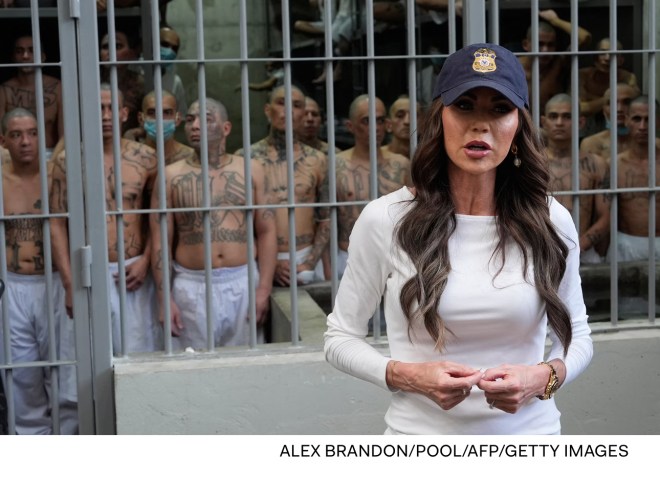
This piece gestated as a review of Sophie Lewis’s Enemy Feminisms, though I see now it has become something a little different. The book so struck me that I quickly joined the dialogue it offered, writing thoughts in the margins and in a notebook, bringing the ideas up to friends and in tangents. These notes, ideas, and conversations collided with a not-unrelated video that I came across three chapters shy of finishing Lewis’s book. This video of Kristi Noem, more recently known for her influencer-style video in front of detained men at the El Salvadoran ‘Terrorist Confinement Centre,’ was of her introductory entrance as Department of Homeland Security (DHS) Secretary. Kristi enters hand-shaking, long dark locks glistening, big shiny white smile, to the tune of Trace Adkins: And you’re/One hot mama/You turn me on/Let’s turn it up/And turn this room/Into a sauna.
As someone who grew up hearing Honky Tonk Badonkadonk regularly on the radio in Bedford, Virginia, the music isn’t shocking. Neither is her shiny hair (though I note the recent-ish MAGA makeover has transformed her locks from a Laura Bush to a Lara Loomer)—and I certainly do not desire a professionalism that rejects sexed-up musical numbers for entrances. Rather, I was captured by the interlocking markers of hyper-white-femininity, motherhood, and fascist logics, all punctuated by Adkins’ libidinous chorus.
In the spirit of Lewis’s narratives of women and feminists who baptised themselves in the rivers of fascism, with all the fullness of their violence, agency, fracture, complexities, and gender, I became fixated on Noem. I did not enjoy following the links to the news, government, and social media sites that Noem’s Wikipedia offered me, nor did I intend to check for daily Noem updates, nor did I know that my feelings of enmity had far deeper yet to go as the months passed. I became morbidly obsessed[1] with—and repulsed by—this woman who stands so proudly for everything I loathe, a woman whose own self-narratisation pieces together a distinctly white, patriarchal fascism with perplexing pro-woman, pro-mother, and pro-empowerment messaging.
Even if I remain reluctant to attribute my beloved feminism to enemies, the idea of enemy feminism made sense to me quickly: my doctoral research taught me much about sex-worker exclusive feminisms, the carcerality of sex work “abolitionists,” and the impoverishment of white liberal feminism in answering to issues of race, class, and ability.[2] When I speak with feminist colleagues, we dismiss much as not “real” feminism. I exchange lengthy voice memos with my friend (and motherhood scholar) about the choice-feminism of some momfluencers—their lean-in capitalism and their classed aesthetics. I watch feminists call for genocide in Gaza; they cheer for it and lend it their pinkwashing language. I see and mourn the language of women, women’s rights, and equality used in racist, classist, paternalistic, transphobic, and genocidal projects. I am beginning to feel the prescient task of acknowledging where-what-when feminisms exist, enemies and kin alike.
Know Thy Enemy
Kristi Noem certainly doesn’t call herself a feminist, though I imagine that the word “feminist,” like DEI, woke, and radical left, has an entirely different meaning in her circles than mine. It is not my desire to name her as a feminist either. But as I read about Noem, I find myself ticking off the languages, actions, and ideologies of her lineage like some kind of enemy feminisms bingo card. I measure her against and alongside Lewis’s cast list, to ask: what kind of enemy is Kristi Noem?
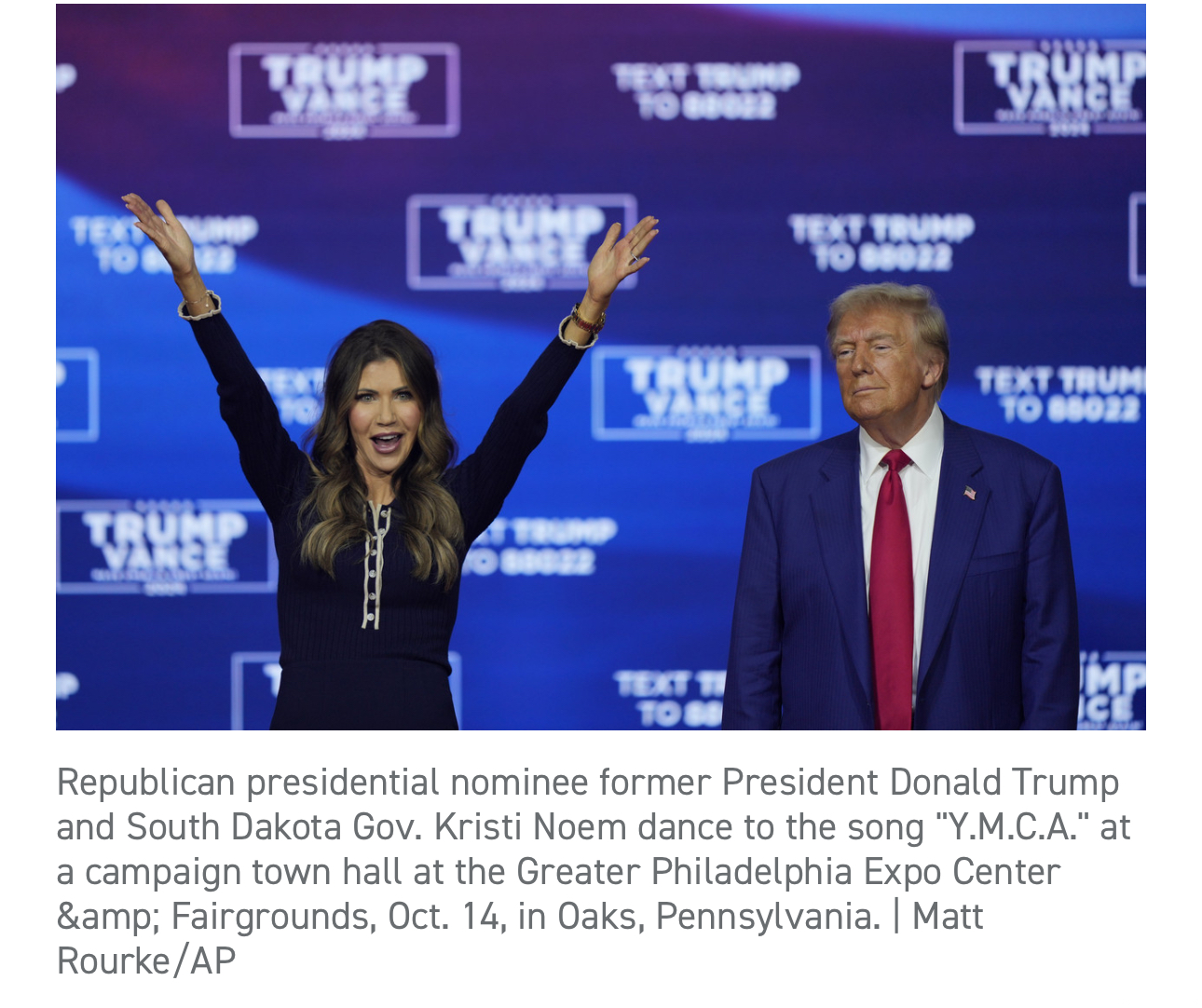
Born in 1971, Noem entered politics in 2007. Prior to arriving on stage that day to the tune of Trace Adkins, she had dressed in ICE agent attire in a social media video to “get the dirt bags [immigrants] off our streets.” Noem has hit firsts and seconds for women in politics: second woman member of the House GOP leadership (2011) and first woman governor of South Dakota (2019). She aspired to be the second woman Vice President of the US, to Trump’s President, before news of her puppy-killing hit the press cycle.
Noem wants to federally ban abortion from fertilisation, opposes the Affordable Care Act, supports Trump’s Muslim Ban, denies climate change, and wants to reopen sales on oil leases in the Gulf and off the coast of Virginia, where I grew up. She was the South Dakota Snow Queen of her high school, developed anti-protest legislation with TransCanada Corporation in response to the Keystone Pipeline protests, and was banned from the Pine Ridge Indian Reservation in 2019.[3] More recently, as evidenced in part by her ICE get-up, Noem has been highly active in the vicious deportation of people she names “violent criminal illegal aliens.”
Saving the Children, or the Pro-Life Feminist
“Governor Noem has a lifelong commitment to defending innocent life” – Governor Noem’s Pro-Life Record
Noem’s aspirations for second-woman U.S. Vice President ended after her autobiographical revelations of shooting to death, in succession, her 14-month-old ‘untrainable’ puppy Cricket and a ‘smelly’ family goat. When a reporter asked her about Cricket, Noem demurred: “That story’s a 20-year-old story of a mom who made a very difficult decision to protect her children from a vicious animal […]”
Noem’s deft and intentional centering of motherhood and “protecting children,” as those of us familiar with save-the-children moral panics may attest, usually work as a “plainly obvious force of good.” As Rebecca Jennings notes, save-the-children sounds a lot better than its implied opposite: fuck the children, forget about them, disregard them. Though this need not be the dichotomy, it is one that Lee Edelman uses to great effect: “Fuck the social order and the Child in whose name we’re collectively terrorised.”[4] The Child, the white Child, often stands in for a promotion of an ideology, of a social order, that is distinctly against life-making and life-having. The Child is at play when segregationists did not want Black children in “their” schools. The Child is at play in the rampant transphobic restraints on gender-affirming care and exclusion of trans children (and adults) in sports. The Child is at play in queerphobic accusations of grooming.
I do not mean here that we should not aspire to protect our children from violence or dog attacks. Rather, we must consider the broader context of Noem’s appeals for protection of the children (not limited to saving her own children from Cricket). When, for instance, Trump indicated he would be seeking a federal abortion ban, then-Governor Noem responded proudly: “@realDonaldTrump is exactly right…this is about ‘precious babies.’ It should be easier for moms, dads, and families to have babies – not harder. South Dakota is proud to stand for LIFE and support babies, moms, and families.”
She does not, however, think it’s the government’s role to ensure that people have the resources to care for their children, and when DHS deported Kilmar Armando Abrego Garcia, removing him from his wife and child, due to an “administrative error,” Noem fought (and is fighting) to keep him in El Salvador. Noem’s wielding of the Child, or in this case the Precious Baby, rings false when we consider the wholly violent extent of reproductive injustices she has perpetuated. As Lewis writes:
“Reproductive injustice is a description of US society: ecological collapse in progress, wages stagnant, workers’ protections under attack, zero healthcare access for many, two million people locked up—all of which threaten people’s ability to care for one another, especially babies and children.”
Noem’s role in these injustices cannot be understated. Her more recent work as DHS Secretary is a continuation of a political career built on such injustices, marginalisations, and rhetoric. Yet we must grapple with Noem’s language, its roots and its webs, even as her actions are in opposition to her words: she is for life, she is supporting mothers, she wants to serve women. Wanting to lead “compassionately” on life, she has expanded Bright Start to “serve more moms.” She signed a law “protecting women” from “abortion coercion” and was lauded by the Susan B. Anthony Pro-Life America group for her consideration of women’s lives. Feminists have long argued that “pro-life” is a linguistically strategic stance not centred on life-making at all; with Noem, as with Lewis’s pro-life feminists, we see this rhetoric expanded, deepened, made material in their harm and their contradictions. Lewis points out that pro-life feminists will often offer “some ‘woman-empowering’ services for mommies-to-be—such as factually inaccurate antiabortion counseling not substantially different from what’s provided in non-feminist crisis pregnancy centers.”
Noem can hardly claim, yet does, that her primary orientation is the preservation of human life, nor the protection of children, nor the safety of women, nor the dignity of families. We have seen the lives that she has destroyed. Yet she has grounded her political career and persona in a narrative that, though highly contradictory, is consistently eager to be “pro woman” with, perplexingly, the trappings of a strident maternity. But here we may encounter a synergy with Lewis’s articulation of the drone-happy military Girlboss, a ‘“sensible” maternalist standpoint perfected in the nineteenth century, blending patriotism with no-nonsense antiutopianism. Noem’s specific mandate on the value of innocent life seems altogether too calculated when we consider the criminalisation, dehumanisation, and violation of those she deems illegal or dirtbags, including fathers, mothers, children. Noem does not care about care, and she does not care about the children. When faced with an enemy who brandishes this maternal white supremacist feminism, we must ask: which children are worthy of your motherly protection?
The KKK feminist; the policewoman
“Where are our women senators?” thundered Alma Bridwell White in 1924 at the New Jersey launch of her periodical Woman’s Chains, “where are our women judges, where are our women jurors?” (The KKK feminist)
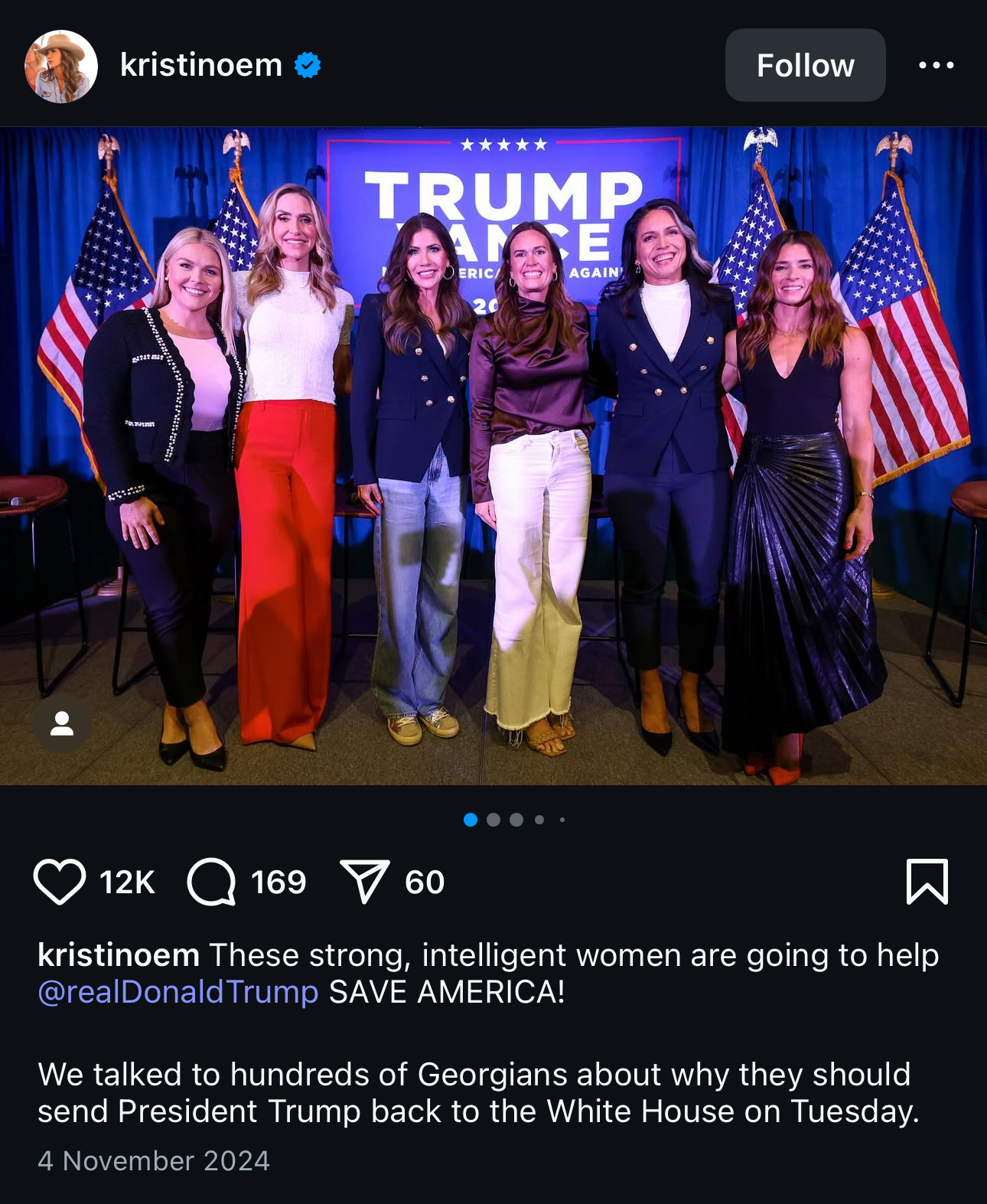
After her viability as Trump’s running mate faded, Noem still believed that a woman should be his running mate. She argued that Trump needed a woman to help his campaign, that the polling supported this. She told a reporter that “one in four Republican women haven’t made up their minds because they want to have a woman talking to them about the issues they care about. And women aren’t monolithic.” I certainly agree with Noem here: women aren’t monolithic. And yet, it seems to me that Noem is demonstrating a uniform allegiance to a particular womanhood, one that is racist in its history and at its core, one that can smooth over discrepancies of gender in the name of racial superiority. As Lewis writes:
“By uniting under the banner of women’s rights, racist women and racist men offer one another a mandate to be patriarchal toward backward “civilizations” […] racist women are often more than willing to prioritize racial over sexed solidarity, and racist men, in turn, are sometimes happy to fight for racist women’s limited equalities.”
Noem wanted women represented in Trump’s administration. Why? I can only assume, especially based on her actions since assuming the DHS Secretary role, that her desire for a woman in the White House is grounded in a longing for a bigger piece of the imperial-power pie. Lewis wishes that she could have concluded that racist feminism “isn’t really feminism,” and I would similarly like to dismiss Noem’s racist girlpower-flavoured ICE actions as not of or related to feminism. But as Lewis reminds us:
“unless we are prepared to say that Mary Wollstonecraft and Emmeline Pankhurst are not part of feminism, then imperial feminism really does come from feminism, not least inasmuch as mainstream feminism itself comes from empire.”
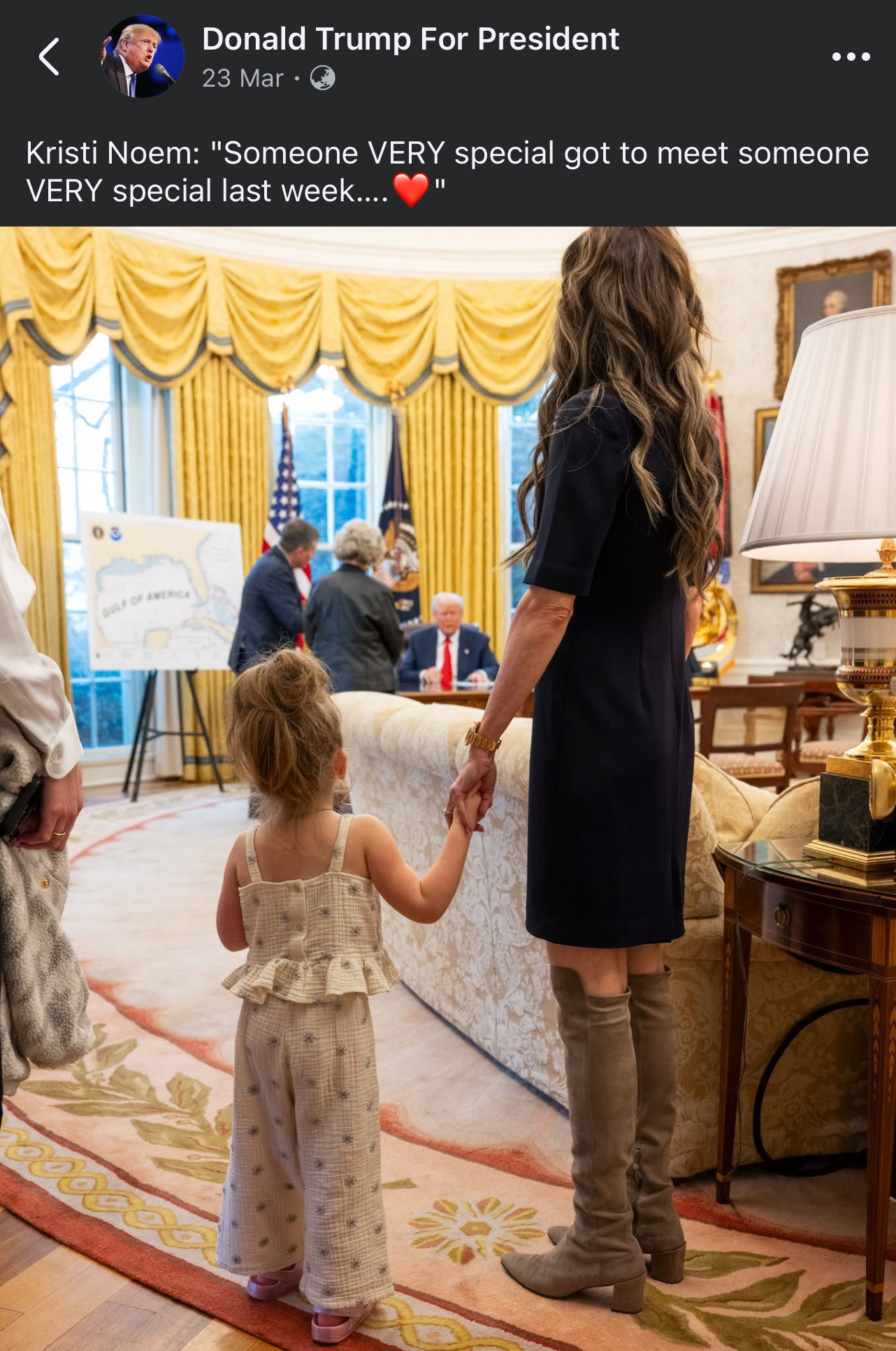
Lewis’s epigraph for the KKK Feminist chapter, a Texas gun manufacturer’s bumper sticker, is right up Noem’s alley: “God made men and women equal. Smith & Wesson makes damn sure they stay that way.” In a 2024 Indiana NRA-ILA Leadership Forum, Noem said that the rights to own guns is “God-given,” paused for applause after she quoted the Second Amendment, deftly referenced the Revolutionary War, and reminded the crowd that God gave them the right to defend themselves and their family. She also reminded the crowd of her own family; she is the grandmother to “Little Miss Addie,” an almost two year-old child who is already the proud owner of a shotgun, a rifle, and a pony named Sparkles: “Now Addie, who you know – soon will need them [guns] […] So the girl is set up.”[6]
The reasons why Addie may need guns soon is not made immediately clear in her talk, though I can begin to fill in the blanks with Noem’s ramped-up recent rhetoric (and actions). The “illegals,” those “worst of the worst,” may very well, in Noem’s imagination or at least in the narratives she chooses, be coming next for her granddaughter. (The two-year-old, luckily, will have a rifle to protect her.) Noem’s efforts to remove all of the people who purportedly threaten the American public—the white, sometimes feminine, American public—are made visible not just in her rhetoric, but more often visually. The imagery of Noem in the El Salvadoran prison, standing in front of bars behind which crowds of shirtless men look out at her, is viscerally confronting for both its influencer-aesthetic and its expansive violence.
Some of these men, torn from their families and lives, White House press secretary Karoline Leavitt hastily (and without evidence) reminds us are “illegals” “convicted of sex crimes against minors.” The apparent disdain for sexual predation seems, to say the least, hypocritical when one considers these women leaders’ reverence for predators like Donald Trump, Corey Lewandowski,[7] or Matt Gaetz (to name a few). But sexual violence by the rich and white man seems easy to dismiss, not useful for the white supremacist immigration regime and its reality TV ICE raids. I again return to Lewis and the history offered:
“a Klan feminist’s bottom line was that there was no such thing as white extrajudicial violence. White violence is always legitimate violence because, in America, it is the police […] The offer that the feminism of lynchers makes to white women is a devil’s bargain, drawing us into the rewards of whiteness as property if we sign away our solidarity—a wicked compensation for our lack of ownership of other forms of property in capitalist societies. Seductive as it may seem when we are hopeless, unsafe, and resentful, it is, and has always been, possible to just say no.”
The Pornophobe; the SWERF; the saviour of trafficking victims
In 2014, then-US Representative Noem spearheaded the passage of a series of bills designed to “better address the country’s sex trafficking crisis.” I am quite familiar with SESTA (Stop Exploitation through Sex Trafficking Act) but had not realised that Noem was so involved in the (bipartisan) passage until I came across Noem’s press release tooting her own horn about her involvement. Beyond her call for gendered surveillance that has for years raised my hackles, I was struck anew by the way she grounds her attack on sex workers in her own motherhood and her own home, at her fear-mongering of the “unconscionable industry” that may impact “our” kids at the school, in malls, and online. Here Noem linked to a video from a series of House Republicans pleading for consideration of our “sisters and daughters” who are being treated as “objects.” Ending trafficking in women seems at first glance a very feminist position—and indeed, for feminists including Andrea Dworkin and Catherine MacKinnon, it very much is.[8] The pornophobe, or the SWERF, is an enemy feminist of which I am painfully aware. It is not a surprise that Noem allies herself with those feminists that run roughshod over sex workers and their lived experiences, dismiss sex work as work, and ignore anti-capitalist “sex work against work” feminist analyses. Noem, of course, reveals the deep hypocrisy of the SWERF’s supposed “anti-trafficking” stance when she displays her own fascistic imagination in videos celebrating the trafficking and torture of “illegal aliens.”
Doing MAGA gender: the adult human female
Despite many MAGA-styled women being perfectly happy to use and purchase gender-affirming care or reject the policing of their own gender presentation on quasi feminist grounds, they also throw their political power and will behind transphobic legislation and anti-trans discourse. As a key and critical figure in transphobic legislation, Noem’s hands are, of course, directly bloodied when it comes to the violent policing and treatment of trans people. Noem is by all accounts an active gender cop. She is a policer of gender presentation, embodiment, and stratification. But any policing of her gender—whether a critique of her shiny new teeth and lipstick, her “dress-ups” as ICE agents and border patrol, or accusations of plastic surgery—is called sexist or misogynistic. Several days after seeing my first video of Noem’s entry to the DHS, set to the tune of horny Adkins, after I spent hours taking pages and pages of notes on her life and persona, after I opened so many tabs on the ICE Barbie that I couldn’t look my laptop in the face, I read a conversation between Emma Heaney and Sophie Lewis in Pinko in which Heaney says, “Cisness, as the racialized presumption of sexed naturalness, actually affords a great deal of gender expansiveness to white bourgeois people […]”
Noem feels mocked for her “cosplay” as an ICE agent. But such mocking does not marginalise Noem. Rather, her decision to again and again show up (in uniform or not) to deportations and raids, is always stringently gendered, influencer-ised, and ready for the “meme” factory, as Melissa Gira Grant wrote for The New Republic. Her power is grounded in her womanhood, in her marketability, in the rush to release ICE and anti-immigrant propaganda. As Jeff Sharlet writes on Noem: “Trumpist rhetoric, from Trump on down, is rife with the idea that ‘their’ women are ‘sexier’ than Left or liberal women […] Trump women, goes the thinking, are ‘real’ precisely because they try hard to perform ‘woman’ […]”
Noem can comfortably show her power—just so long as she contains it within a still-just-as-narrow spectrum of femininity: “maternal” or “sexy.” That is, her womanhood is true and better because of how hard she tries to reach and perform “woman.” This rejects the idea of gender as expansive, as capacious, as unbound, as free. This rigidity of femininity, the boxed-in-ness of woman, seems at odds with the right wing woman’s exhaustive process of doing gender, their MAGA-flavoured white ciswomanhood. Yet they ostensibly settle such contradictions by weaponizing the very category of woman. As Governor of South Dakota in 2022, Noem signed a bill into law that bans trans girls and women from women’s sports teams. At the news conference for the signing, she cited “fairness for girls” among other reasons for the bill. Noem’s shaky, restricted sisterhood and gender must have, like her America, strong and violent borders.
Enemy feminisms
Enemy Feminisms is a genealogy of anti-liberatory feminism—of racism and white supremacy, transphobia, whorephobia, of colonisation and imperialism, of carcerality and fascism, of forced reproduction and policing—all by figures that we cannot quite dismiss as “not feminism.” Noem is, without a doubt, an enemy of liberatory feminisms, and even of a few feminisms with more reformist than liberatory tendencies. But can we say she is not of the genealogy of certain feminisms? That she is not using the language of feminist values and arguments for her flavour of fascism? Is the best way to fight this iteration of state violence to close our eyes to the culpability of our own genealogies?[9] Noem promotes transphobia by citing women and girls’ struggles for equality. She defends her ICE Barbie look by pointing out different standards for men. She stumps for the rapist Trump and encourages him to choose a woman for VP. She triumphantly tears families apart while asserting her support for mothers and families.
Noem clearly and intentionally speaks from the position of a woman. She pitched herself “as a governor, rancher and mom passionate about family values and a second Trump presidency” and rejoiced when her granddaughter met Trump. When billionaire Mark Cuban said that Trump is intimidated by strong, intelligent women and does not associate with them, Noem responded pithily: “game on, buddy. I’ll take you on any day in a debate or maybe even arm wrestling.” Noem’s eagerness to assert herself against masculinity and its power conjures Lewis’s description of Alma Bridwell White, the bishop and Klan feminist: “the bishop’s feminism was full frontal: this was a woman who challenged men’s power ferociously every day before breakfast.”
Noem is clear that she wants to be characterised as a strong and intelligent woman and believes that at least some women should have a significant role in business, politics, work—in other words, she does not seem an adherent of the anti-feminist tradwife archetype that permeates much of the conservative political landscape. Noem even articulates capacities for women beyond just “women’s issues.”[10]
Lewis’s book gives language to grapple with these spiky contradictions: we can understand that Noem is an enemy and a willing inheritor of a myriad of enemy feminisms. To ignore the specific feminist-flavoured empowerment modalities that she and her ilk subscribe to is, I would argue after finishing Lewis’s book, to risk not fully knowing thy enemy.
Towards a liberatory feminism
What Lewis does so well in Enemy Feminisms is to provide not only specific articulations and genealogies of these enemies, but to also delineate a liberatory political vision for feminism that is against these enemies. We can decide how we will orient with and against such inheritance, particularly for white feminists such as myself. Only once we grapple with what feminisms have wrought—both in their enmity and in their liberations—may we push the battle forward, with clarity, against our enemies and towards an abundant, liveable, and capacious world.
The interwoven lineages of feminism are difficult to parse; their intimate entanglements are both frightening and necessary to confront. I end here with Lewis’s words, hoping that more and more feminists become oriented, in community, towards a utopian, liberatory horizon:
When it comes to feminism, it is always easy to kill something, mock something, deflate something. Nonetheless, in print and on the streets, an extraordinary coalition is denaturalizing capitalist gender, building monstrous affinities, and seeking ways to communize care.
Peyton is a teacher, researcher, and writer from Virginia living in Aotearoa New Zealand. She is especially interested in liberatory feminisms, social reproduction, friendships/alternative kinships, and feminist abolitionism.
[1] Lewis quotes sex-worker liberationist Frankie Miren in her final chapter: ‘it’s hard not to be morbidly obsessed with the people who hate you, especially when they’re so visible and relentless.’
[2] This too, is where Lewis starts. I realise that I was distinctly ready for this book, as I tried to piece together an argument about how feminist sex work ‘abolitionists’ are not feminist abolitionists.
[3] In 2024, eight out of nine tribes in South Dakota banned her from their tribal lands, meaning that the South Dakota governor was banned from almost 20% of South Dakota (after racist remarks linking tribal leaders and drug cartels).
[4] Edelman, L. (2004). No future: Queer theory and the death drive. Duke University Press, p. 29.
[5] Trump criticised states with bans that make no exception for rape or incest. South Dakota has no exception.
[6] Sparkles, like the drone operator at Creech Air Force Base, Sparkle, that Lewis discusses in the Girlboss. I paused at the coincidence: “So, if “women” are “taking over” the war machine, as both of the aforementioned journalists reported, then we really ought to rejoice alongside them. Power to the Sparkles!”
[7] Whom Noem allegedly had an affair with – he has been accused of sexual misconduct by a Republican woman and donor: https://nypost.com/2023/09/15/kristi-noem-corey-lewandowski-affair-shakes-up-trump-running-mate-stakes/
[8] Enemy Feminisms.
[9] I am reminded, as I ask this, of Hazel V. Carby’s “white woman listen!”
[10] “I think that as we look across the country women don’t just want to talk about women’s issues. We want to talk about everything that’s important to our economy, to jobs, to our children’s futures.”
 blindfieldjournal.com