By Matt Hanson
Prefatory note: The affliction of ethnocentric, religious nationalism continues to ravage the inherent pluralism of human societies throughout the globe, especially in and among the authoritarian Turkic states of the former Soviet Union and for the 80-plus million citizens under the rule of perhaps the world’s leading instigator of modern “Turkishness” as legislated by the powers that be in the republic of Turkey. This essay is a historiographic attempt by a leftist American journalist in Istanbul to unravel and expose the religious diversity of an international ethnic group whose historic communities span the Balkans to Western China and beyond, expanding upon the Westernness of the West, the Easternness of the East, the Turkishness of the Buddha.
When one thinks about the spiritual leanings of Turkey (officially the Republic of Türkiye), Buddhism isn’t the first religion one thinks of. According to the state, 99.8% of the population is registered as Muslim, with as much as 90% of the population following Sunni Islam. Yet, the country has a long history of Buddhist practice. Mahayana Buddhism (Uluğ kölüngü meaning “big chariot”) was widespread among the early Turks, who adapted the religion to their living conditions, culture, and historical traditions. And while not overly prominent, Buddhism’s legacy can still be found in Turkey today. In 2023, the website studybuddhism.com had 29,000 visitors from Turkey, who read 46,000 articles in Turkish over the course of the year, indicating the tradition still has some enduring popularity in the region. But how did Buddhism first enter into the region and what was its lasting imprint on Turkish society?
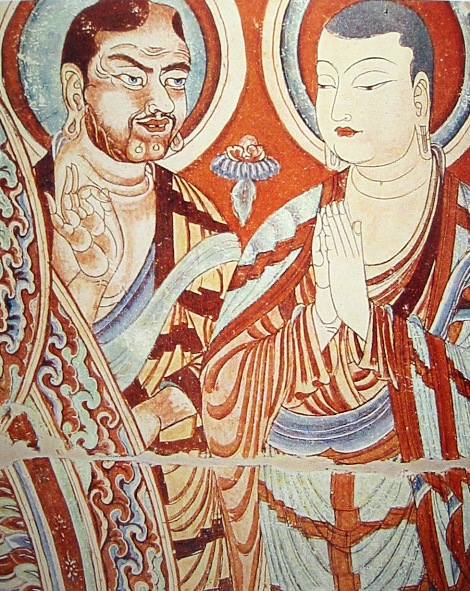
The most prolific example of Buddhism in Turkic societies is represented by the Uighur minority of China, whose fate under Beijing’s genocidal reeducation camps has made world headlines in recent years. Today, Uighur people in Xinjiang and their growing diaspora are largely Muslim, but prior to the 14th century, they had developed a millennium of Buddhist practice, art, and heritage. “If we are going to talk about a Turkish Buddhism I think it should be called Uighur Buddhism, because there was no other Turkic group before or after the Uighur on the stage of history that continued this religion in groups as large as they did,” said Burak Can Deveci, a Turkish philologist and expert in Old Uighur texts. This undying, if obscure, legacy is reflected across the Uighur diaspora in the scholarship and traditions of various Turkic societies, from Istanbul to Siberia.
Religious Identity in Pre-Modern Turkey
Unlike Chinese Buddhism, Indian Buddhism, or Tibetan Buddhism, defining Uighur Buddhism as a distinctive subculture that might be called Turkic Buddhism still raises question marks for scholars like Deveci who regularly pore over primary documents in the Old Uighur language. This rejection of a specifically Turkic Buddhism is due to the politicization of religious conversion in Turkey that held sway during the heyday of Uighur Buddhism, from the 4th to the 14th centuries, and in many ways is still seen today.
Turkic societies across Central Asia began to follow Islam after the Muslim Qarakhanids vanquished Uighur Buddhist civilization in the 10th century. Medieval Uighur Turks were no different than the Turks of modern day Turkey in that their religious ideologies changed according to the political zeitgeist. In 1923, Ottoman imperialists fell to Occidental secularists whose curiosities encompassed pursuits familiar to their peers in academies throughout Eurasia.
When Turkey passed its surname law in 1934, displacing Ottoman honorifics and religious title with Western patriarchy, Turkish scholar Ömer Hilmi Buddha named himself after the subject of his reverent scholarship. A newly appointed professor at Ankara University in 1949, he even asserted that Shakyamuni Buddha was a Turk. According to his sources, the Shakya clan of Siddhartha Gautama’s lineage descended from a mixed, Central Asian ethnic group, the Saka Turks.
Today, scholars generally agree that Buddhism first reached Turks in Central Asia during the second century of the common era under the reign of the nomadic, Hellenized Kushan Empire following their expansion to north India, where they patronized Buddhism. For the next two hundred years there was peace in and around what is now modern-day Uzbekistan and Afghanistan. The era, known as Pax Kushana, led many of the locally-emergent Turkic states and dynasties to embrace Buddhism.
Due to Islamic conversion and communist rule, the last surviving historical communities of Turkic Buddhists remain close to where the origins of Turkic languages first enter history. Among the Yellow Yugurs in western China’s Gansu province, some 15,000 people practice a Tibetan-Turkic fusion of Mahayana Buddhism. The Tuva, a Turkic-speaking people in Siberia, revitalized their republic’s capital of Kyzyl when the largest Buddhist monastery in Russia opened there on April 28, 2023.
In 1889, Russian scholar Vasily Radlov published the Orkhon inscriptions as a series of texts, evidencing the earliest roots for Turkic linguistics in what is now Mongolia. He went on to found the discipline of Turkology. While the field has been co-opted by ultranationalist extremists in Turkey and Central Asia to bolster the ethnocentric rhetoric of the strongman dictatorships that define the geopolitics of the region, the common historical tie to a single language group from Thrace to Xinjiang and beyond also reveals a shared affinity for Buddhist beliefs.
The Ottoman soldier Kemal Mustafa, born in Thessaloniki, lived up to the title “father of the Turks,” when he separated religion from the state to establish the republic of Turkey in 1923. He and his supporters began their soul-searching affair with Western secularist principles that, under two decades of Islamist populism in the 21st century, are beginning to wear thin.
In letters to his successor, Atatürk addressed Turkey’s first prime minister İsmet Inönü as Namo, a Sanskrit epithet that appears in Buddhist texts to indicate respectful admiration. According to Turkish academic Merthan Dündar, Atatürk referenced over ten books on India, China and Buddhism while corresponding with Inönü, who became Turkey’s second president.
“Atatürk was trying to establish a nation. So, history was very important, especially the pre-Islamic era of the Turks,” Dündar confirmed, referencing his scholarship as a social scientist specializing in Japanese-Turkish relations through language and literature at Ankara University. Leading up to the nationalist Turkish historiography that Atatürk pioneered, intellectuals in late Ottoman society were already presaging interest in pre-Islamic, Buddhist Turkic culture.
Before lifting the Ottoman veil from Anatolia, adventurous academics from East and West explored Russian and Chinese Turkestan in search of distinctive, cultural histories that might draw a more complete map of human diversity. The academic formalization of Turkology as a distinct discipline in the last decade of the 19th century culminated during the First World War, coinciding with the rise of Turkish nationalism as the prevailing sociopolitical ideology for at least six modern nations.
Turkey’s founding father interpreted Turkish identity as pluralist, even universalist, so that its diverse peoples could enjoy the individual rights of citizenship. To Atatürk, all who stated they were Turks were, and so, entitled to the privileges afforded by national sovereignty. In reality, Turkey’s minorities suffered from vicious exclusionary policies, in some ways more than ever in the process of replacing multinational imperialists with ethnolinguistic nationalists.
Atatürk represents a flawed but inspired vision of tolerance, as he joined his scholarly and literary peers to research deep into their pre-Islamic, Turkic heritage for multicultural links to the rest of humanity. Pseudoscientific theories abounded, conspiring that Turkish was the oldest language in the world, or that Native Americans descended from Siberian Turks. In the process of modernizing, however, Turkish thinkers were reintroducing their cultural history to its Buddhist roots.
Modern Turkish Buddhism
Buddhists in contemporary Turkey are few and far between. But there is a presence, even if it is demographically negligible. Near the citified shores of the Marmara Sea, on the Asian side of the Bosphorus in Istanbul, Turkish-German practitioner Cengiz Oezcan travels from his home in Hamburg to serve all of those who are interested in Buddhism in Istanbul, where he was born.
“We opened our center in Turkey ten years ago. At that time I did research about what exists in Istanbul in terms of Buddhism. I found almost nothing except for one or two people offering meditation courses. I think it’s still the same,” said Oezcan.
“People come to us, showing interest in Buddhism and meditation, and when I ask them ‘how did you find us,’ they said we did a web search and ‘you were the only one [to come up].’ So, still nothing. Yoga is very popular, but Yoga is not Buddhism. They also meditate but meditation is only one part of Buddhist practice,” Oezcan says. “Islam is ingrained in the culture, even if people are not religious there are still many aspects of Islam in daily life and Buddhism is seen as another religion. That’s why people are reluctant to follow another religion. We try to be seen as more of a meditation center than a Buddhist center.”
Every modern Turkic nation-state, particularly Turkey, conflates Islam with Turkishness and weaponizes dynastic heritage to supplant electoral democracy through majoritarian politics, bolstering draconian judiciaries that grant immunity, or privilege, to perpetrators of hate crimes. The Republic of Tuva is the sole exception where Turkic Buddhists are the municipal majority. In the Sunan Yugur Autonomous County of China, where the Yellow Yugurs are the only other traditional Turkic Buddhist community in the modern world, they share political representation with the Han Chinese as well as Tibetans.
“Muslims were always interested in controlling the tax on the Silk Route,” says Buddhist scholar Alexander Berzin, who formulated his own postcolonial theory of Central Asia and India following British rule, so as not to repeat their tropes of demonizing Muslims and victimizing Buddhists. In the 1990s, he met with professors in Turkey and academics in Kyrgyzstan, Uzbekistan, and Kazakhstan, including a brief visit with Kalmyk Mongols in Xinjiang in 1994, discussing Muslim-Buddhist relations.
“The professors [in Xinjiang] were very open and interested in Buddhism but there were no Buddhist groups there yet and as such, the only spiritual group that I spoke to was in Kazakhstan, Almaty. [But] they were open to different spiritual practices, including Buddhism,” Berzin says.
In April 1990, sponsored by the leading Buddhist organization of the Soviet Union in Moscow, Berzin became the first Buddhist teacher in modern times to lecture on Buddhism in Tuva, appearing at the Tuva Research Institute of Language, Literature, and History for forty people. At the end of the Soviet thaw after the fall of the Berlin Wall, the Tuvan people were motivated to return to their premodern religious heritage as Buddhists, even if bewildered at the crossroads of their historical revitalization, scarred by generations of forced atheism.
“The people had no current knowledge of Buddhism. They certainly weren’t Muslim. They had invited Buryats to start rituals, and they were planning what they would do. They didn’t have a Buddhist tradition. There was a Mongolian form of Tibetan Buddhism present there but only in terms of archaeology,” Berzin says.
“How has Buddhism developed in all of these areas in the post-communist period?” Berzin asks. “It’s primarily the older people, I must say. The people are tremendously interested in reviving their customs. It is [now] flourishing.”
Currently, many Turkish academics specialize in Old Uighur as part of a broader field encompassing premodern Turkic languages and religions. From the 4th to the 14th centuries, Uighur Turks practiced one of the most prolific forms of Buddhism in and around what is now Xinjiang. Due to their nonviolent submission to the invading Mongols, their religious culture entered Mongolian Buddhist scriptural tradition.
In contrast to the Nalanda school of philosophical monasticism which led to Tibetan Buddhism, Uighur Buddhists focused much of their practice on the Golden Light Sutra and the accumulation of merit through devotion and chanting rituals accessible to their lay community.
“When researching the history of Buddhism among Turks, I was surprised to learn that Buddhism survived more than one millennium among Turkish states and dynasties,” says Turkish scholar Münevver Ebru Zeren, citing scholars Wolfram Eberhard and Emel Esin. “It’s quite visible that Buddhism’s cultural impact survived in Turkish literature and art during the Early Islamic period.”
“The contribution of Turks to the flourishing of Mahayana Buddhism in China is not well-known in Turkish history and not well accepted in Chinese history. It’s especially important to trace cultural continuity in Turkish art and literature. We can not explain the development of Turkish art and literature without investigating Manichaean and Buddhist cultures,” Zeren explains. “Turks respected all religions practiced by their multi-national subjects, as evidenced from the Hun (Xiongnu) to the Ottoman states.”
A Literary Motif
While waves of research expeditions followed the discovery of the Orkhon inscriptions to further develop the burgeoning discipline of Turkology, luring scientific explorers from Finland, Britain, Germany, France, Japan, Sweden, and China, Ottoman-Turkish writers were expressing varying degrees of erudition with regards to Buddhism. In 1890, as the first Russian delegation to East Turkestan gained ground, Ahmet Mithat Efendi wrote his historical account Thirty Thousand Buddhists in Paris, first as a newspaper serial before it became a book.
As a prolific author of progressive essays on Russian literature, the first Western-style story in Turkish literature, and patron of female writers, including the famed Fatma Aliye, Mithat read French periodicals, and, in response, took up their concerns, embracing ethnological interest in Buddhism after attending the 8th Orientalist Congress in 1889, which was held in Stockholm and Christiania. Putting his fictions aside, his detail of Buddhism’s spread across Europe can be read as his liberal, progressive attempt to bridge Ottoman and European sympathies.
Today, Ankara University offers a robust course of Buddhist studies thanks to the German Indologist Walter Ruben, who, as a Jew, came to Turkey fleeing Nazi persecution. In 1949, the university made Hilmi Ömer Buddha a professor in its Faculty of Theology. His theory that the Shakyamuni Buddha belonged to the ethnic Saka Turks, whose population numbered one million in sixth century India, was later echoed by Western scholars Michael Witzel and Christoper I. Beckwith, who also claim that the Saka clan of Buddha’s supposed origins descended from Central Asian nomads.
Often pseudoscientific and very politicized, Eurocentric early social science was not the only way in which Buddhism influenced Turkish modernism. The poet Asaf Hâlet Çelebi deepened his poems with Buddhist motifs, integrating concepts of the Bodhisattva, Siddhartha, and Mara into verse that celebrated the diversity of religious beliefs throughout the world since antiquity. Çelebi, who is also lauded as Turkey’s first surrealist poet, had mystical inklings as the son of adherents to Rumi’s school of Sufism. His 1953 book of poetry is titled Om Mani Padme Hum.
“It’s important to see this work as a product of a time when there was a great interest among Turkish historians and intellectuals for the development of Turkic empires and states in pre-Islamic Central Asia, spurred in part by the importation of European narratives about the history of the region,” says British Library curator Michael Erdman.
Çelebi, in a stanza from his poem, “Siddhartha,” praises the memory of Shakyamuni Buddha in verse with a bit of Turkish wordplay blended into an enlightened metaphor of universal interdependence:
Sidharta Buddha/I am a fruit/My tree is the universe/Neither tree nor fruit/I am swimming in a sea/Om mani padme hum! (three times)
Author Bio: Matt A Hanson is an independent, freelance journalist and editor from Massachusetts based in Turkey since 2016. He is the Istanbul desk editor at ArtAsiaPacific magazine and weekend editor for the leftwing Turkish news outlet ANKA Review. He has written for many publications including Jacobin, In These Times, World Literature Today, Artforum, Words Without Borders and Hyperallergic. He founded the archival press project FictiveMag.com to merge literary fiction with art criticism.
 blindfieldjournal.com