by Katie Stone
Here at last is my strength./I am not the water-/I am the wave,/and rage/is the force that moves me.
—Susan Stryker, My Words to Victor Frankenstein Above the Village of Chamounix: Performing Transgender Rage (1994)
When Victor Frankenstein shot Elizabeth, I laughed. In this one ridiculous moment I saw how completely the unsettling, thorny and endlessly challenging monster which is Mary Shelley’s Frankenstein; or, the Modern Prometheus (1818) had been defanged by Guillermo del Toro in his 2025 adaptation.
For those who are not constantly and obsessively re-reading Shelley’s novel, this is not what happens in Frankenstein (1818). In the original text, Victor Frankenstein creates a being whom he immediately abandons. The Creature is left alone in the world, he is abused by all who meet him, and he develops a great rage at humanity generally and his maker specifically. He seeks out Frankenstein and demands that this absent father make things up to him by creating for him a companion. Frankenstein initially agrees but, after months of delay, destroys the Creature’s would-be bride. The Creature then swears revenge and, on Frankenstein’s wedding night, he kills Elizabeth – the woman to whom Frankenstein had been betrothed since they were both children.
Fidelity to the details of the original text is not the issue here. There are few things less interesting than critical appraisals of adaptations which seek to berate the adapter for making changes. Shelley’s Frankenstein has spent the past two centuries being reimagined again and again – torn apart and stitched back together to serve the narrative purposes of social worlds that Shelley could not have imagined. Its versatility is a testament to the vivid appeal of the dream which drives the text: a dream of a new kind of being who rejects the world as we know it. Whether that new being embodies an exuberantly queer escape from the compulsory cisnormativity of Britain, as in The Rocky Horror Picture Show (1975), or whether they enact a bitter campaign of revenge in response to the neoimperial violence of the US invasion of Iraq, as in Frankenstein in Baghdad (2013), in successful responses to the text the Creature creates a profound rupture with the status quo.
My issue is not that del Toro changes the details of Elizabeth’s death. Although her deliberate murder at the hands of the Creature does make for a far more dramatic moment than the messy encounter in del Toro’s film where she embraces the Creature, Frankenstein attempts to shoot him and Elizabeth jumps in front of the bullet. My disappointment with his adaptation derives from the effect that his changes have on the radical potential of Shelley’s text – a potential which, in my view, lies in an underlying rage in the world as it is. Del Toro takes the moment where the Creature breaks entirely from his maker’s authority – finally ensuring that Frankenstein will be as wretched and isolated as himself – and transforms it into an accident, produced by Frankenstein’s own petty jealousies and selfish negligence of all around him. This move may seem sympathetic to the Creature and his cause. After all, del Toro is absolving the Creature of the crimes Shelley has him commit. And yet, by placing the murder weapon in Frankenstein’s hand, del Toro gives the scientist the power to shape the film’s narrative. Gone is the Creature as a figure of furious negation of the current order of things. In his place is a wounded being, who helplessly watches the violent actions of his selfish father. The Creature is robbed of agency at the same time that the ethical complexity of his violent rejection of the world is stripped away. Del Toro may believe that it was only when he “was younger” that he “made films, fairy tales, or fables that said, ‘Monsters are good and humans are bad’,” but Frankenstein is just that, a shadow of what it could have been.[1]
This rendition of Frankenstein as depoliticised moral fable is particularly disappointing given del Toro’s previous work. From Hellboy (2004) with its revivified Nazis, to Pan’s Labyrinth (2006), set in Franco’s Spain, and on to Pinocchio (2022) and its portrait of Mussolini’s fascist forces, del Toro has returned repeatedly to the threat of fascism and the possibilities of fighting against it. While an explicit engagement with fascism was always unlikely in his Frankenstein – although del Toro did shift the action fifty years so that everything could plausibly look a bit more steampunk, so why not a little further? – it is sad not to see any anti-fascist energy in this new adaptation. As Victor Erice memorably demonstrated in The Spirit of the Beehive (1973) – where two children watch James Whale’s 1931 Frankenstein and are thus inspired to aid the strange Creature, a revolutionary hiding from Franco’s government, who they find in a barn – there are anti-fascist resonances to be found in Shelley’s text. Perhaps the most obvious of these is Shelley’s critique of state violence. This is a thread which runs throughout Frankenstein (1818). For example, one of the novel’s set pieces is the trial of Justine Moritz, a young woman whom the Creature has framed for the murder of Frankenstein’s younger brother, William – a murder which the Creature has himself committed. Shelley presents this trial as a mockery of justice. Elizabeth states that “all judges had rather that ten innocent should suffer, than that one guilty should escape”, while Justine describes how the confessor, “threatened and menaced, until I almost began to think that I was the monster that he said I was”.[2] Justine’s eventual execution, following the false confession into which she was pressured, gives rise to Elizabeth’s wholehearted rejection of both the death penalty itself and the society which gives rise to it. As she puts it:
When one creature is murdered, another is immediately deprived of life in a slow torturing manner; then the executioners, their hands yet reeking with the blood of innocence, believe that they have done a great deed. They call this retribution. Hateful name! When that word is pronounced, I know greater and more horrid punishments are going to be inflicted than the gloomiest tyrant has ever invented to satiate his utmost revenge (p. 67. Emphasis in original),
On top of this execution of an innocent woman, Shelley includes several wrongful incarcerations in her narrative – including that of a Turkish merchant whose conviction in Paris is driven by Islamophobia and anti-immigrant sentiment, and that of the young Frenchman who attempts to break him out of prison. In Frankenstein (1818), then, the law is not a reliable arbiter of guilt and Shelley uses the text to denounce the frequent injustices suffered by innocent people in court.
This is not, however, the most profound critique of the law in which Shelley engages. This can be found in her portrayal of the Creature as a self-avowed criminal. The first time that Shelley’s Frankenstein is reunited with his creation the Creature has already murdered his younger brother. When the Creature demands that Frankenstein hear his story, and create for him a bride, he is speaking not as a wrongly accused innocent but as someone guilty of inflicting terrible harm. And he confesses this guilt freely. What he does not do, however, is accept that Frankenstein has the right to condemn and punish him for his wrongdoing. Speaking to his creator, the Creature cries: “You accuse me of murder; and yet you would, with a satisfied conscience, destroy your own creature. Oh, praise the eternal justice of man[!]” (p. 78). Here, the retributive violence which fuels contemporary understandings of justice is shown to be illegitimate even when those accused of crimes are not in fact innocent. By refusing to take up the role of a penitent who deserves to be punished, Shelley’s Creature evokes the prison abolitionist mantra that no one, whatever their past crime, is disposable. He will not allow the harm he has done to be written off solely as the product of his individual failings. Instead, the Creature forces Frankenstein to take responsibility for abandoning him and, in effect, criminalising his existence. It is to this criminalisation that the Creature attributes his own desire for violence; stating: “I was benevolent and good; misery made me a fiend” (p. 78). The genuine ethical quandary with which both Frankenstein and Shelley’s readers are faced with here – which requires navigating systems of dispossession, criminalisation and familial violence – is utterly unlike that seen in del Toro’s film. When del Toro’s Creature returns to Frankenstein he has, as far as his creator knows, done no harm to anyone. Nevertheless he is met with unrelenting scorn from the scientist, who wishes to banish him from existence simply for the crime of living in the world. There is no effort to unpick crime from genuine harm here, or to grapple with the ethics and efficacy of vengeance. Where Shelley’s Frankenstein must answer the question: “How should I treat my strange child knowing that he has killed my little brother?” del Toro only seems interested in asking whether his Frankenstein should keep abusing his strange but entirely blameless child – a question which his audience can immediately answer, and which Frankenstein himself totally fails to face.
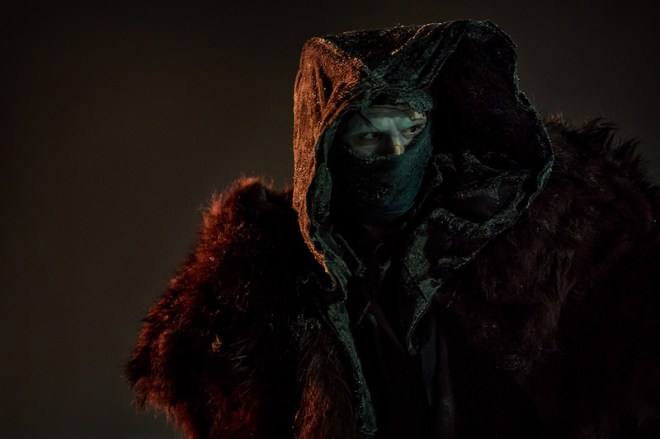
Defenders of del Toro’s film will at this point note that his Creature is also a killer. Indeed, the film opens with a huge fight scene in which the Creature kills six unnamed Danish explorers as he attempts to reach Frankenstein, who has found sanctuary aboard their ship. We later see him literally tear apart the bodies of a pack of rather poorly rendered CGI wolves, and he likely kills several of William Frankenstein’s friends, as well as William himself, in the fight which follows Victor shooting Elizabeth. These extravagant set pieces – which feature bodies flung across rooms and the vast structure of the Danish ship rocking in response to the Creature’s blows – are, however, worlds away from the intimate and considered murders of Shelley’s Creature. Where Shelley depicts violence as stemming on the one hand from the world’s criminalisation of the Creature, and on the other from the Creature’s very deliberately channeled rage at the world, del Toro seems more interested in violence as spectacle. His vast action sequences involving the Creature fighting off crowds of men and beasts serve to justify the extravagant sets which have become a hallmark of his production design. There is no space in this film for the quiet horror of Shelley’s Creature strangling the seven year old William Frankenstein on learning his name. Indeed, del Toro embeds the death of William, who in his production is a fully grown adult, into a combat between the Creature and a group of men who run to the scene of the crime on hearing Frankenstein shoot Elizabeth. Frankenstein then shouts – “It attacked her! It attacked her!” – prompting the men to rush the Creature and prompting the Creature to throw them off.[3] The head injury which William sustains in this combat later kills him. Again, death at the Creature’s hands is transformed from deliberate, rage-filled murder into a messy near-accident. Even William is not interested in condemning this wild act of self defence as criminal. In perhaps the film’s most on the nose line, the dying William blames his brother for all the violence that has befallen them; stating: “You are the monster” (02:06:44). The Creature-as-criminal is nowhere to be found. Nor can we find him in del Toro’s depiction of the Arctic, although here he is the aggressor. Del Toro distances the Creature’s acts from the human world of crime by stressing his monstrous inhumanity. In the scene with which the film opens the Creature is presented as a hulking, otherworldly force. He seems impervious to gunshots and when they see him on the ice the sailors mistake him for a polar bear. Del Toro’s Creature may kill many more people, far more indiscriminately, than Shelley’s, but any attendant social commentary has here been stripped away in favour of the drama of a big action sequence on a big boat.
This stripping away of the political import of violence is also in evidence in those few moments where del Toro’s Creature does reflect on his actions. In Shelley’s novel, when the Creature speaks of human society he focuses on the injustices of racial capitalism (although not of course in those terms). He describes how, eavesdropping outside the cottage of an exiled French family, he “heard of the discovery of the American hemisphere, and wept […] over the hapless fate of its original inhabitants” (p. 95); how he “heard of the division of property, of immense wealth and squalid poverty; of rank, descent, and noble blood” (p. 96). Summing up these lessons, he states: “I learned that the possessions most esteemed by your fellow-creatures were, high and unsullied descent united with riches” and that “without either [a person] was considered, except in very rare instances, as a vagabond and a slave, doomed to waste his powers for the profit of the chosen few” (p. 96). In contrast, del Toro’s Creature exclusively frames violence as part of the natural order. In the place of discussions of the division of property or the extraction of profit, the Creature states:
A feeling became clear to me. The hunter did not hate the wolf. The wolf did not hate the sheep. But violence felt inevitable between them. Perhaps, I thought, this was the way of the world, it will hunt you and kill you just for being what you are.
Here, del Toro obscures those structures of power which serve to alternately legitimise and pathologise violence under capitalism, depending on who is being hurt. In their place is the mystifying spectre of Nature as the apparent source of violence. This is not just a dumbing down of Shelley’s message. It is a distortion of a text which has been held up by feminists for generations as a story of creation which denies Nature the authority to act as the arbiter of what is good and right and true.
There are glimpses of another Frankenstein beneath the skin of del Toro’s film. You can see them in the horror that the young Frankenstein feels at his mother’s death in childbirth. He refuses to accept that her death was unavoidable – that childbirth is natural, and naturally deadly – instead determining to dedicate himself to ending maternal mortality through his experiments. This seems like a revolutionary direction in which to push Frankenstein, a novel which has had an important place in feminist thought precisely because of the potentially emancipatory effects of Creature-making as a form of artificial reproduction. Mary Shelley’s mother, Mary Wollstonecraft, died in childbirth. Shelley herself lost several children in their infancy. She was writing at a time where childbirth was even deadlier than it is today, and many of the deaths caused were far from inevitable. If Victor’s birthing of the Creature had been framed as an alternative to women having to give birth under the care of misogynistic doctors who treated them with a mixture of disregard and active violence this would have been a deeply exciting film. Alas, it was not to be. After the film transitions away from Victor’s childhood to his years at medical school he literally never mentions childbirth again. Nor does he attempt to share his research with anyone once it has succeeded. His transformation into the father he hated for abandoning his mother is total.
This is just one of the windows of possibility that del Toro slams shut in the film. We get a glimpse of a critique of arms dealing, of an exploration of nonhuman life and the lessons it might have for us, and of the relationship between the creation of new life and the treatment of illness in living people. But each of these glimpses is gone as soon as it arrives – transformed into another of Frankenstein’s petty grievances, or blotted out by one of his tantrums. Perhaps the most obvious stifling of this film’s potential comes in the scene to which I keep returning, where the Creature is reunited with both Frankenstein and Elizabeth. After pleading with the completely callous Frankenstein for a companion to accompany him, the Creature is enraged at being rejected. He flings Frankenstein across the room while pledging vengeance; stating: “If you are not to award me love, then I will indulge in rage. And mine is infinite[!]” (02:04:02). This is the Creature that I had been waiting to see – the one who was unequivocal in his rejection of injustice and who made those who oppressed him feel his wrath. And then Elizabeth, hearing the commotion, enters the room and the Creature melts into her arms, his limitless rage immediately finding its limit as he becomes just another of del Toro’s monster men with chiseled abs who are loved by palely beautiful women. He is not a being filled with rage at the world. He is the Beast tamed by Beauty – turned into an image which can be enthusiastically shared on Victoriana and Gothic Romance Pinterest boards. Having Frankenstein, the bitter Gaston in the corner, then shoot Elizabeth completes the stifling of the Creature’s rage. Any idea that the film might be fuelled by the Creature’s anger at the world, rather than by Frankenstein’s selfishness, lasts for all of two seconds. Del Toro demonstrates that his priority is to create a version of Frankenstein which looks beautiful and tells a story of monster men, and monstrous men, and the women who love them. What he does not seem interested in doing is capturing the revolutionary potential of Shelley’s text – a text whose fiery wrath at the world has been burning for over two hundred years.
The silver lining, of course, is that Frankenstein will never truly die. While del Toro’s film has failed to live up to its promise, Shelley’s fans can always look forward to the new, angry shapes that her story will take. And in the meantime there are hundreds of texts which have been touched by the myth of the Creature, where his rage lives on, unlimited.
Author bio: Katie Stone is an independent researcher living in Colchester in the UK. She writes about utopianism, childhood, science fiction and vampires. Katie is a co-founder of the Utopian Acts network and of the Beyond Gender research collective. She is currently working on a book about Frankenstein. Her work can be found at www.katiemcgregorstone.co.uk.
[1] Guillermo del Toro in Luis Martínez, ‘Guillermo del Toro revives Frankenstein: “Only Monsters Play God”’, El Mundo: America, 21st October 2025, <https://www.mundoamerica.com/entertainment/2025/10/21/68f74fa0e9cf4ac0408b4584.html> [accessed 08/01/2026].
[2] Mary Shelley, Frankenstein; or, The Modern Prometheus: The 1818 Text (Oxford: Oxford University Press, 1993; first published 1818) pp. 65 and 66. All further citations are to this edition and are included in the body of the text.
[3] Frankenstein. Directed by Guillermo del Toro, Netflix, 2025. 02:05:13. All further citations are to this production and are included in the body of the text.
 blindfieldjournal.com