By Aya Anzouk
In July 2008, a 32-years-old niqab-wearing Muslim woman of Moroccan origins was denied French citizenship despite having lived in the country since 2000 along with her husband and their three French-born children. She had initially applied for citizenship in 2005 and appealed the unfavorable decision three years later. The Council State of France, the nation’s highest administrative court, upheld the same ruling, claiming that the applicant demonstrated “insufficient assimilation”. Referred to as the “Burqa case,” Silmi’s narrative garnered significant attention from global media, igniting a passionate debate regarding the validity of the grounds upon which this decision was initially made. However, this discussion gradually diminished, while Faiza Silmi’s Burqa emerged as a central focus in this ongoing debate. In a masterclass show of paternalistic domination, French officials weighed in on the situation, arguing that Silmi’s religious practices directly conflicted with the Republic’s values of gender equality. On the other hand, French media outlets contended that her failure to comply with instructions during her interview as demonstrated by her refusal to remove her face veil so that she could be identified, was the main reason that led to her being denied citizenship. Later on in 2009, former French president Nicolas Sarkozy, publicly proclaimed that the face veil has no place in the French republic because it is a sign of subservience and a stark infringement upon women’s rights. Sarkozy even went on to propose banning the headscarf on French streets, thus not only seeming to conflate personal opinion with legal analysis but also demonstrating a broader strategy of “Othering” that instigates division even within the sociocultural sphere.
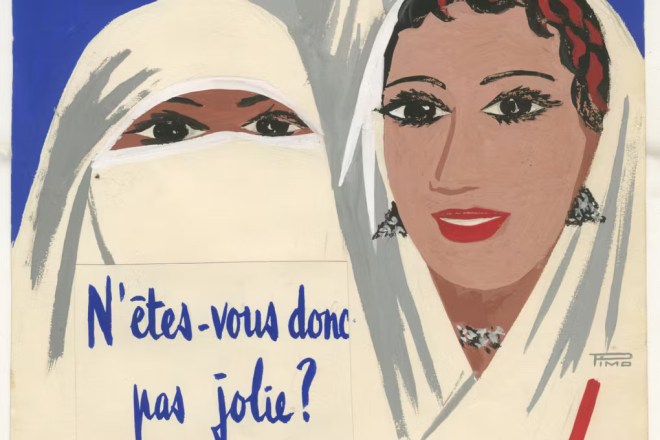
By synthesizing legal analysis, media discourse, and historical accounts of gendered colonial oppression, this article argues that France’s selective Laïcité and legislative othering of veiled Muslim women is a continuation of its colonial habit of forcibly unveiling North African women, one which reduces their bodies as battlegrounds for psychological warfare. The word ‘veil’ will be used thoroughly to refer to various religious garments worn by Muslim women (e.g., hijab, niqab, and burqa) unless I am referring to a specific piece of clothing.
The Colonial Gaze Revisited
Orientalist Origins
In his 1978 landmark oeuvre, Edward Said defines Orientalism as a Western-invented discourse created with the primary goal of portraying the “Orient” as a culturally inferior geopolitical entity, as a means of justifying the West’s violent colonial conquests in the region (Said, 1995, pp. 1–5). It is a tool of power acquisition which relies on derogatory stereotypes and objectionable false narratives, and is therefore very intentional in its production of a perfectly tailored image used to dehumanize the victimized. In slightly different words, Orientalism is the making of the “Other”: a process which passively entails a simultaneous formation of the self through a proclaimed contrast of the qualities that this ‘other’ is presumed to possess (Said, 1995, pp. 6–8). It is an epistemological process through which the West distinguishes itself from the woman-oppressing rest (Said, 1995, p. 207). By defining the “Orient” as barbaric, oppressive, rough, and fundamentalist, the West defines itself through remoteness in place of proximity (Said, 1995, pp. 40–42).
Orientalist art was a 19th century artistic movement and one of many mediums through which the west was able to paint a mystical image of the East. Within the narrow boundaries of that image, there was yet another symbol, hidden in plain sight and rendered an icon for exotic sexual imagery: The Eastern woman (Alloula, 1986). The faint and hushed existence of this woman is central to the imaginary Orient which seemed to preoccupy the cultural productions of Western travelers. While the oriental man was often described as a barbaric individual whose animalistic traits were highly accepted by the reactionary collective, the oriental woman became the subject of male fantasies despite her “restricted presence” in the public sphere. Therefore, one can easily claim that the politicization of the hijab began with the genesis of the Orient in the cultural fabric and knowledge production systems of the West on ‘the rest’ (Said, 1995; Abu-Lughod, 2002).
Moroccan Presence in France
According to a 2024 report published by the National Institute of Statistics and Economic Studies (INSEE), Moroccans constitute about 11.7% of France’s foreign population while 48,9% of foreign nationals living in France are of African origin. According to the same source, it is estimated that more than half of the immigrants who arrived before 1974 came for employment-related purposes and were later on joined by their dependents or extended family members. Aregbeshola and Adekunle (2024) argue that migration trends are shaped by colonial history, citing new patterns of coerced or forced labor, neoliberal source extortion, and language imposition in the Global South as potential factors determining popular migration destinations. Additionally, the “postcolonial” world order offered little in the way of restorative justice for most African nations, which continue to grapple with the remnants of a crippling colonialism as well as the shape-shifting architectures of Western domination. In the same sense that these material conditions have shaped migration flow into fortress Europe, they have also shaped expectations of assimilation and integration among migrant communities. The expectation of acculturation from ethnic minorities residing in the west often comes with the command of embracing white supremacy as world-making. Many legal scholars have argued that the relinquishment of non-white cultural identity became a crucial part of the standard naturalization process, and that failing to affirm the presumed universalism of the Laïque brings about severe consequences, exposing many contradictions that lie at the heart of the nation’s republican project (Beaman, 2020; Ware, 2015).
France’s ongoing racial project cannot be separated from the uptick in white nationalism in many western countries, including some where claims to indigeneity are not necessarily rooted in histories of territorial belonging or ancestral presence, but rather constructed through narratives of cultural purity and civilization superiority. In a nation like France that claims to be colorblind, whiteness operates as the default identity ought to be assumed and even performed by all French nationals (Keaton, 2016; Beaman, 2018). France is a nation that does not formally recognize different ethnic and racial identifications, hence the lack of categories such as ‘white’ and ‘black’ in the French consensus (Beaman, 2018). Yet, middle-class children of North African immigrants in France are often racialized as non-white, which inherently negates the supposed colorblindness of French society (Keaton, 2016; Beaman, 2018). This logic carries a stark resemblance to how France defines and practices its values of Laïcité, as it attempts to dismiss real implications of religious differences within its society and ends up invoking an identity-crisis among its marginalized communities, particularly those whose visible practices of faith are deemed incompatible with the dominant visions of Frenchness.
The Case of Faiza Silmi
Hijab and Secularism
The French Republic adopted Laïcité or secularism as one of its foundational principles after being introduced by the 1905 constitutional French law separating Church and State. Whereas the codification of secularism into law was not unique to France, Laïcité was the byproduct of a long and painful history of monarchic totalitarianism enabled by the catholic church. Secularism, often misread as a modern universal principle, is defined by British Anthropologist Talal Asad as a power-centralizing Western project that excludes religion from the public sphere and fails to deliver the neutral separation it promises (Asad, 2003). This is especially true for the Laïque French republic, which claims to have moved away from the domination of church on state, and yet remains trapped in the paradoxical logic of domination it continues to perpetuate against its own minority religious communities. By replicating its mechanisms of power, adopting its dogmatic and dichotomous paradigms, and resisting reasonable critique, the secular state mirrors ancient clerical oligarchy in its utmost glory (Asad, 2003, pp. 20–25).
Anthropology professor and author, Mayanthi Fernando, argues that the state-enforced ban on all religious garb underscores the “otherness” of the hijab encoded into the secular culture. No longer perceived as a religious symbol or even a mere piece of fabric, the hijab was deemed an attack on French identity and national values (Fernando, 2014, pp. 8–10). During the height of the infamous 2003 headscarf controversy, Le Figaro, a prominent newspaper in the country, referred to the hijab as a “provocation incompatible with the values of the Republic”. This public outrage, equally manufactured as it is organic, cannot be separated from its colonial etymology (Fanon, 1967, Chapter 1). In this sense, French secularism operates as a means to an end, drawing borders of racial and cultural belonging rather than a neutral and universalist legal principle. Its paternalistic moral guiding has always been an essential element to Western rhetoric aiming to justify colonialism, more recently encoded into a legal contract between the French state and non-EU foreigners, referred to as the Contrat d’intégration républicaine (CIR). This contract is a mandatory, legally-binding document that seeks to define the fundamental values of the republic and subjects individuals to legal liability in case of a violation of this agreement (Orgad, 2015, pp. 87–94). Formerly referred to as the Contrat d’accueil et d’intégration, the CIR offered unmatched potential to be an efficient exercise in nation-building, reconstructing notions of identity and belonging to correspond with the emerging social landscape of French society. Instead, it became more focused on defining and shunning all that is deemed “unfrench” such as the Islamic veil (Orgad, 2015, pp. 87–94).
Secularism’s Theological Paradox
The case of Faiza Silmi gave rise to an important legal question: Does a state have the authority to impose a legally binding social/moral contract with no regard for contextual differences? While some might argue that the answer to this question in the context of France’s laïcité is a resounding “yes,” there are further nuances to consider. Silmi’s beliefs were met with a refusal of her application to become a French citizen, and her behavior was judged for its incompatibility with French values rather than its legality (Roy, 2011, p. 851). In Western political discourse, Islam is often regarded as an obstacle for statecraft and deemed “too incompatible” with secular western values. In many ways, such statements can be interpreted as admissions of the non-universality of secularism but are often dismissed as a matter of cultural deficiency rather than a shortcoming of secularism itself. It is precisely because of the moral inferiority ascribed to the East, and to Islam by extension, that this incompatibility is deemed as a symptom of an inherent flaw in this non-western belief system. This is where state power begins to play a role in codifying this assumed moral superiority into law, so as to offer it an indisputable sense of legitimacy. In reality, it is the intentional and systemic exclusion of Muslim communities in the Laïque republic that continues to obstruct a just state-building process accessible to all constituents of the secular nation (Fernando, 2014, pp. 8–10).
Instead of acknowledging the historical trajectory of its creation and its deep-rooted expansionist objectives, Western states continue to uphold this narrative of universality to justify the enormous power that secularism has over Global frameworks of governance (Asad, 2003; Asad et al., 2013; Fernando, 2014). There is also this false yet widely accepted idea that secularism and theocracy are two opposing systems of government. In reality, secularism and theocracy both follow the same methodology in the process of establishing a state ideology, as both assume a theological and moral authority over opposing systems of governance. Both systems have the ideological and legal tools that could potentially allow for authoritarianism, and yet only one is regarded as a threat for democracy, while the other is hailed as a quintessential proposition for modern state-building (Asad et al., 2013). In many cases, secularism imposes certain practices that evoke a “civilizing” mission, reflecting the colonial logic historically employed as a justification for what is irredeemably immoral (Fernando, 2014, pp. 165–170).
Gendered Islamophobia
Islamophobia is defined as the irrational fear of, or hostility towards Muslims and Islam. It is a phenomenon that can manifest in hate crimes and acts of violence that carry significant repercussions for the Muslim community as a whole (Turpin-Petrosino, 2022). Gohir (2015) argues that the Islamic head covering only became a common practice among members of the Muslim diaspora following the rise of post 9/11 islamophobia, asserting that state restrictions or bans of religious garments only undermine gender equality and fuel gendered islamophobia.
While some of the most outspoken anti-Muslim politicians and media personalities invoke gender inequality as a pretext for their anti-Muslim rhetoric, their professed concern for Muslim women fails to truly address the supposedly unique subjugation imposed on women by Islam, and in most cases only attempts to mask a broader agenda of racialized prejudice (Gohir, 2015; Beydoun & Sediqe, 2023). Whereas “masculine islamophobia” portrays Muslim men as the violent and aggressive protagonists of fundamentalist terrorism, “feminine islamophobia” helps reproduce the stereotypical orientalist image of the meek and submissive woman, who is in desperate need for a white savior (Beydoun & Sediqe, 2023).
The Body Politics of Veiled Women
If the hijab is seen today in France as a potential threat for national security and a challenge to secularism, it is partially because of the role that similar religious garments have had in orchestrating the undisputed defeat of French colonialism in Algeria. As personal as the decision to wear a veil is, it is also a political act whether one understands it as such or not. For decades, women’s bodies have been particularly used as battlegrounds for ideologies and policies, thus prompting a wave of resistance against this persistent appropriation of their bodies as symbols of cultural or political agendas (Ahmed, 1992).
Although not special in this regard, French colonialism has facilitated the appropriation of Muslim women’s bodies through many transgressions that were mainly aimed at weakening the morale of the nation as a whole, thus priming them for colonial rule. French photographer Marc Garanger, deployed to Algeria in 1960, was ordered to take portraits of Kabyle women as they were forcibly unveiled and displaced from their villages (Falęcka, 2023). Those pictures are still used today both in the international art scene and in academia. One can easily recognize a certain defeat in the faces of these women, who would have otherwise gone on to live the rest of their lives without having their tale of gendered victimhood put on full display to the masses. For the French colonizers, the unveiling of the Algerian women symbolized psychological domination and control (Fanon, 1967). Algerian and Moroccan women often wore the Hayek – a long traditional garment that fully covers the face and body – which served not only as a piece of cultural identity, but also as a tool used to aid armed resistance movements by smuggling weapons or ciphers and coded messages between resistance fighters.
While the Laïque French republic today has no “unveiling policy” like the one it had enforced in Algeria, it is important that we understand its legislative othering of veiled Muslim women and their ostracization from the public sphere through laws like the hijab ban as a continuation of a colonial legacy. The headscarf, one of the more ‘moderate’ forms of religious expression adopted by Muslim women, evokes the memory of the North African veil as a tool of concealment and a hushed participation in armed resistance. French lawmakers and media personalities are often reluctant to acknowledge this historic connection, and yet it is very clear in the language they use to talk about the Islamic headscarf and its supposed defiance of French secular values. It is not the secular that stands in contrast to the hijab; it is the colonial.
French Muslim women of North African origin experience the veil as a highly contested site of body politics, where their bodies are racialized and disciplined. Media portrayals of the veil in the west are closely tied to its coverage of Islam and Muslims as a whole. Through constructing the veil as a decontextualized and easily digestible visual cue for female oppression and subservience, Western media is able to posit Islam as an antidote to “Judeo-christian” religious iconography despite the strong resemblance between the two (Said, 2008, Chapter 1).
(Un)belonging in the Laïque
Keaton (2006) posits that, for numerous young French women of African descent, national identity functions as a protective mechanism, safeguarding them from potential deprivation of their civic rights. In contrast, it fails to provide this protection when ‘culture’ is redefined as nationality, thereby hindering the development of national identity for France’s ethnic populations. Despite being legal citizens of the republic, these ethnic ‘Others’ are still subject to the obligation of negotiating their identity and belonging within a nation that has become increasingly preoccupied with achieving monocultural national unity (Keaton, 2006; Fernando, 2014). Through legislative othering and negative social attitudes that manifest in the form of hate crimes or microaggressions, veiled Muslim women are systematically deterred from participating in public life.
CONCLUSION
While the experiences of veiled Muslim women vary widely across a variety of sociopolitical, economic, and cultural contexts, it is important to recognize the shared objective realities that many women can attest to and avoid falling into the futile repetitiveness of “politics of recognition” (Fraser, 1999). Intersectionality serves as a correction to the universalism fallacy within feminist discourse, yet it can pose a serious issue if used strictly to highlight micro-identities by fragmenting political struggles to the extent of burning bridges of solidarity and proactive allyship. As theory cannot entirely be divorced from practice, we must allow sameness and difference to coexist and balance each other. This article does not seek to paint a homogeneous narrative that every veiled Muslim woman must agree with, as the idea of a singular narrative shaping up multitudes of intersecting identities is impossible. What it rather attempts to do is highlight the common experiences often subconsciously concealed by the heterogeneity of struggles within our collective identity, for understanding the systematic procedure through which we are othered is as vital as recognizing the particularities of our individual struggles. Proactive feminist solidarity requires that we form alliances that rally around causes pertaining to gender inequality regardless of how it manifests in real life situations, and to engage in a life-long process of learning and unlearning what systems, beliefs, and biases conserve these inequities, both within our communities and within ourselves.
In 2010, Faiza Silmi shared a status update with le Monde, a French newspaper commonly dubbed “far-left”. After getting a divorce, Faiza began working for the first time and decided to remove the niqab (Bars, 2010). Silmi maintains that her decision to remove the face veil was her own, and that it reflects a renewed moderate understanding of her faith. Yet, her story invokes a thought-provoking conversation about the complex relationship between law and selfhood within the borders of a modern nation, as one continuously defines and redefines the other. It calls into question the idea of personal choice in contrast to societal pressure, of which the legal sphere is yet another powerful mechanism. Ultimately, it compels us to ask: Do we shape laws, or do laws shape us?
Author bio: Aya Anzouk is a Moroccan writer and psychology student whose work explores psychiatric hegemony and the afterlives of colonialism in this sector. Drawing on subaltern perspectives, she writes about epistemic injustice with a focus on more culturally grounded approaches to psychology. Her work has appeared in Morocco World News, Tempest Magazine, Blind Field Journal, Al Mayadeen, Awan, and Al Tanweeri.
Works Cited
Abu‐Lughod, L. (2002). Do Muslim women really need saving? Anthropological reflections on cultural relativism and its others. American Anthropologist, 104(3), 783–790. https://doi.org/10.1525/aa.2002.104.3.783
Ahmed, L. (1992). Women and gender in Islam: historical roots of a modern debate. Choice Reviews Online, 30(02), 30–1125. https://doi.org/10.5860/choice.30-1125
Alloula, M. (1986). The Colonial Harem. University of Minnesota Press.
Aregbeshola, A. R., & Adekunle, I. A. (2024). Demystifying colonialism and migration: An African perspective. Research in Globalization, 9, 100262. https://doi.org/10.1016/j.resglo.2024.100262
Asad, T., Brown, W., Butler, J., & Mahmood, S. (2013). Is critique secular?: Blasphemy, Injury, and Free Speech.
Beydoun, K. A., & Sediqe, N. A. (2023). Unveiling: The law of gendered Islamophobia. California Law Review, 111(2), 465-527.
Beaman, J. (2018). Are French people white?: Towards an understanding of whiteness in Republican France. Identities, 26(5), 546–562. https://doi.org/10.1080/1070289x.2018.1543831
Said, E. W. (1995). Orientalism. Penguin Books India.
Said, E. W. (2008). Covering Islam: How the Media and the Experts Determine How We See the Rest of the World (Fully Revised Edition). Random House.
Falęcka, K. (2023). Woman as Battleground: Marc Garanger’s Identity Photographs from Algeria and their Long Afterlives. Third Text, 37(1), 44–60. https://doi.org/10.1080/09528822.2023.2211468
Fanon, F. (1967). A dying colonialism. Grove Press.
Fernando, M. L. (2014). The Republic unsettled. In Duke University Press eBooks. https://doi.org/10.1215/9780822376286
Fraser, N. (1999). Social justice in the age of identity politics: redistribution, recognition, and participation. In L. Ray, A. Sayer (Eds.) Social justice in the age of identity politics: Redistribution, recognition, and participation (pp. 25-52). SAGE Publications Ltd, https://doi.org/10.4135/9781446218112.n2
Keaton, T. D. (2006). Muslim girls and the other France: Race, Identity Politics, and Social Exclusion. Indiana University Press.
Asad, T. (2003) Formations of the Secular. 1st edn. Stanford University Press. Available at: https://www.perlego.com/book/745157 (Accessed: 22 October 2025).
Ware, L. (2015). Color-blind racism in France: Bias against ethnic minority immigrants. Washington University Journal of Law and Policy, 46(1), 185–244. https://openscholarship.wustl.edu/cgi/viewcontent.cgi?article=1848&context=law_journal_law_policy
Orgad, L. (2015). The cultural defense of nations: A Liberal Theory of Majority Rights. Oxford University Press.
Bars, S. L. (2010, December 22). Vivre sans voile intégral, le nouveau départ de Faiza. Le Monde.fr. https://www.lemonde.fr/societe/article/2010/12/22/vivre-sans-voile-integral-le-nouveau-depart-de-faiza_1456635_3224.html
Gohir, Shaista. “The Veil Ban in Europe: Gender Equality or Gendered Islamophobia ?” Georgetown Journal of International Affairs, vol. 16, no. 1, 2015, pp. 24–33. JSTOR, http://www.jstor.org/stable/43773664 . Accessed 3 Nov. 2025.
Roy, O. (2011). Secularism and Islam: The theological predicament. In J. R. Bowen, E. A. Kepel, & J. L. Esposito (Eds.), Religion and human rights: An introduction (pp. 849–853). Oxford University Press.
Turpin-Petrosino, C. (2022). Islamophobia and acts of violence: The Targeting and Victimization of American Muslims. Oxford University Press.

