By C. Josephine Hunt
0 – How I Found this Movie
There is a micro-genre of horror films in which I have an interest– captivity-forced-feminization horrors, I would call them. Films, in short, in which one man captures and physically confines another while forcing him to play-act the role of a woman and an ideal heterosexual partner, for a presumed male horror-film-watching audience. Examples include Almodóvar’s El piel que habito (2011), Du Welz’s Calvaire (2004), and DiNovis’s Surrender Dorothy (1998). These films are quite different, and rather rarer, than those in which a grotesque caricature of a transgender woman is the monstrous villain (The Silence of the Lambs, The Rocky Horror Picture Show, Sleepaway Camp, etc. etc.)– the feminized male, in the films in question, is the sympathetic protagonist (although his condition is sometimes punishment for past misdeeds), and crucially he is feminized involuntarily, having started the film as a man.
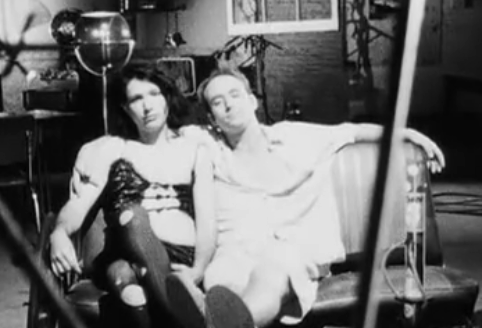
I discovered Kevin DiNovis’s 1998 “dark comedy of gender manipulation,” Surrender Dorothy, through the grapevine of transgender female social media, naturally enough. That’s one of only two, small and insulated spaces on the internet that seem to be talking about it. In that one the film is compared favourably and unfavourably to more conventional and consensual narratives about men becoming women, and half-joking speculations are made about whether DiNovis– who wrote a movie in which he directed himself crying in a skimpy white dress while Peter Pryor croons into his ear that he’s a pretty girl, a nice girl, a good girl– might have been giving voice to something deep inside he hasn’t admitted to himself yet. The other is “disturbing movie” junkies, straight and male by default, who watch it to get grossed out by the bit when Lanh is forced at gunpoint to (possibly?) cut off his penis. Nobody else remembers this movie, from what I can tell. Although, Roger Ebert liked it– he’s quoted on the cover calling it “genuinely unsettling” (And it is. Your jaw hits the floor at just the right moments).
There’s a quotation that echoed in my head again and again over Surrender’s relatively brief runtime. It’s not from a grand master of screenwriting or a great feminist theorist, but from former New York City mayor Andrew Cuomo, who is reputed to have told a male staffer in 2019 that “you’d be a good-looking tranny, if you get a good set of tits.” A real charming guy he is.
Cuomo seems to be in much the same state of mind as Pryor’s arrestingly pathetically-meek-turned-effortlessly-domineering Trevor, a quiet dishwasher so overwhelmed by his frustration at women he can’t control that he decides to make one he can out of the only raw material available– the decidedly straight, decidedly male unemployed heroin addict lodging in his apartment, DiNovis’s Lanh. Both Trevor and Cuomo, I suggest, are revealing something significant about what gender is to heterosexual men who desire patriarchal ruling-class-status over women.
Though these men are often the sort to say that sex-gender is an immutable, natural substance, as impervious to human re-shaping as the gravity of a distant black hole, in fact they find it quite conceivable that it should be plastic and subject to correction when it serves them, serves male objectives. What they find shocking and horrifying is that it should be rendered so flexible in service to someone else– in service to anyone but a heterosexual male.
1 – What Do Straight Men Want?
The question that animates this micro-genre of films is: what is the origin of the object(s) of heterosexual desire? When a man wants a woman, what is it that he wants, and from whence does this desire, and its object, come? Men have written reams of lyric and narrative on the question of what women want– it is only fair we return the favour.
For Plato writing his Symposium, the nature of love was defined not by those features it has, but by its want of what it has not. Lacan said something similar about the nature of desire– lovers go looking for what they lack, or for what Other they believe will soothe the wound of some absence in them. But what they want is the feeling of pursuing the filling of the absence– not anything out there, external to themselves, that they could ever find. For Beauvoir, the male subject goes looking for an object on which he can enact his will and affirm himself as a conscious subject.
This presents a problem for him, in that women are not the passive and receptive objects this relation asks us to be– woman must be disciplined and controlled, not only because this is how man affirms himself, but because without this disciplining into an agreeable shape she will not remain available to affirm himself against, will not be the object he convinces himself it is her nature to be, for him.
“Men have presumed to create a feminine domain – the kingdom of life, of immanence – only in order to lock up women therein” (Beauvoir). Women, as we actually are, as conscious actors, cannot but be disappointments to the yardstick patriarchal hetero-male desire holds up against us. And yet, insofar as an object for that desire is what we are taught and disciplined to be, indeed no society has yet invented with lasting consistency some other sense of what a woman is (if anything). We are engineered to behave as what we at once are and are not.
Heterosexual man’s desire for heterosexual woman, then, is not a desire for some natural object existing already in the world. Certainly it is not a desire for women as the acting subjects we in fact are. It is a desire for an object he constructs for himself, within himself, and then beats the world outside into shape to present him with (how Kantian!). Woman, of course, has her own inner life, her own relation to the markers and acts that constitute her social being– but both are inscrutable to him.
In the film, Trevor is a heterosexual male with a problem– women do not present themselves as agreeable objects for the taking. His female coworkers stand above him, a humble dishwasher, on the totem pole of his restaurant workplace, and above even them are customers– lit ethereally as they go about dining (immanent, living), only parts of them shown (hands, mouths) like goddesses too far above the lowly Trevor to fully capture even in the eye, let alone the mind, the hands. He worships them, kneeling like a penitent to masturbate while choking on a stolen fork used by a female customer, but also, plainly, hates them. He cannot own them; they, insofar as they buy for a set time his living labour-time from the employers who have bought it first, own a piece of him. And this, thinks Trevor, is not how a woman should relate to a man in the dialectic of heterosexual desire.
Trevor, then, constructs a woman for himself better suited to her proper place, out of the material available in what he already has under his power (where his woman belongs)– Lanh, a man. But this is not homosexuality; this is, importantly, if a deviation from the typical morality of its society, still not a real deviation from male heterosexual desire. When a despondent Lanh begs for negation of the objectified position of receptivity he has been forced into, repeating over and over that “I’m not a faggot, Trevor,” Trevor only affirms: “I know you’re not; and neither am I.”
Essential to the scene is that neither is lying– this desire is heterosexual. This is where Cuomo is important. To think that Cuomo, in telling another male that a male surgeon could edit him into an appreciable object of heterosexual desire, is revealing a hidden bisexual desire for other male subjects misses the mark entirely– what he is revealing is that the female object of male heterosexual desire is constructed by the male.
2 – More on the Difference Between Dorothy and Buffalo Bill
One of the distinctions I have made above between a captivity-forced-feminization horror and a transgender caricature in horror (Sleepaway Camp is an arguable complication of the difference) is the protagonist being involuntarily feminized, to his own horror and confusion (Lanh), as distinct from an antagonist who voluntarily feminizes himself, to the horror and confusion of the audience and the other characters (Buffalo Bill). The distinction between these character types, both of them fragmentary and funhouse-distorted images of the real-life mutability of sex, the very real material possibility of turning a male into a female and vice versa, is illuminating of several factors in the nature of cisgender heterosexual patriarchal gendering.
It is important that, as constructed under patriarchy, man and woman are not truly parallel or symmetrical roles. One is the positive ideal that tops the great chain of being in patriarchy’s ideology (which every actual man is more or less terrified of failing to measure up to); the other is only– what is below him, what he acts upon. Man and woman do not inhabit separate worlds presented to separate subjectivities; both of them occupy his world, in which he is encouraged to act and she discouraged. Beauvoir says: “in reality, women have never [yet!!!] pitted female values against male ones: it is men wanting to maintain masculine prerogatives who invented this division[.]” The female is, at least so far as patriarchal gendering is concerned, merely negative.
Thus, it is salient and understandable, in the social forms to which man has been conditioned, for a man to be forced into femaleness, reduced from actor to passive patient. By contrast, the desire for femaleness, or even more explicitly the demand, in a transsexual or otherwise, is impossible and incomprehensible. It is a desire for something that has been defined only as lack, as emptiness to fill, and one which transforms it into a positive, creates an opposing subject-principle to answer against it. Thus the humiliated male subject is an appreciable target of empathy; the female transsexual, relative to the dominant world of the heterosexual bourgeois male, stands unknowably behind an impenetrable wall, and can be only feared and wondered at. And thus transmisogyny: i.e., the particular oppression of trans women and the ideological denigration of transfemininity, i.e. of the female as a conscious principle one chooses to pose against the male one. The particular intersection of misogyny and transphobia, and dialectical third moment of synthesis surpassing the two, which characterizes the oppression of trans women. Transmisogyny punishes trans women and girls at once for failing to be men, the preferred class for patriarchal culture, and wanting to be women, the denigrated one– misogyny– and for trying to be women, in defiance of a patriarchal gendered order which insists one cannot become what one is not assigned to be– transphobia.
And yet simultaneously, though the male victim-protagonists in these films are knowable and sympathetic, they must also be objects of scorn. And here it is very interesting that Surrender Dorothy bills itself as comedy– it doesn’t have many jokes as such, unless Lanh’s entire situation is the joke. Calvaire, another film of the type, does not bill as a comedy in any respect, but reviews have still centered on its “humor”. What exactly is the joke in the forced-feminization-captivity horror film? I think, indeed, it is precisely the absurd suffering of its protagonist.
As an object of disdain, the function of a character like Lanh (Dorothy, the name forced on him by Trevor, in the film’s closing credits) for his male audience is not simply an unsettling one which disturbs the fixedness and sureness of their maleness, but also a reassuring one– perhaps that poor sod fell short of manhood, but not I. I measure up! I measure up in ways he never could, and so I may laugh, and know I am superior.. This is another way in which man and woman, as statuses, are asymmetrical– while a woman may be told her behaviour is mannish or un-womanly, this is only an insult and does not really mean what it says; no amount of such insults implies she will get the preferential treatment men do (if they did, they would not after all be insults). But the status of men, being the ruling class, is somewhat more precarious, and must be so, to remain prestigious– man, if he is womanish, is in real danger of losing status, as woman is not really offered any chance of gaining it if she is mannish.
The function of spectacular punishment of men, or those who have fallen out of that class in status, for straying from maleness serves the function of the public execution for manhood as an institution. It on the one hand terrifies and disciplines– this could happen to you, if you fuck up– and on the other mawkishly reassures– it hasn’t yet, because you haven’t! Well done! These films have to be taken as comedies because the reassuring function of the hapless protagonist only works if he is an object of scorn and mockery the male viewer holds himself in firm contrast against; if he becomes too much the object of empathy, if it is too easy for the viewer to imagine himself in the protagonist’s place, then the film begins to unsettle him; it is genuinely horrifying.
We might suppose, then, that watching these films and laughing at them, just as watching Silence of the Lambs and cringing at Bill’s obviously phony transition, serves a propaganda function for patriarchal gendering. Yet it is not only with laughter that we react; in our horror and honest sympathy, there is potential for something else.
3 – We’re All in Someone’s Torture Basement
The kernel of radical philosophical value in DiNovis’s film is the realization that all attributions of metaphysical identity as male or female, man or woman, to persons on the basis of their biological or social attributes, and all political and behavioural expectations on their basis, are as arbitrary, fragile, and incoherent as Trevor’s imposition of womanhood onto Lanh. And, in the case of the hegemonic and involuntary attributions of division into gendered classes, with unequal expectations for labour and for control over the labour-power of others, that predominate in patriarchal society– they are as cruel, as arbitrary, and as based in malignant self-interest as the enforced microcosm of patriarchal gender in the film. More succinctly: all assignations of sex and gender under patriarchy are as arbitrary as the ones made in a torture basement, and usually as cruel and involuntary. Usually, however, the basement is so vast we cannot see that we are in it.
I do not mean only, as was said popularly before the publication of Butler’s Gender Trouble and as continues to be said by those who have badly misunderstood its arguments, that gender is a social expectation papered over the real metaphysical substance of sexed bodies. This falsely anti-patriarchal premise is, in fact, only a covert re-assertion of exactly what is false in the ideology patriarchy itself feeds to its own subordinated classes: that there is any metaphysically real substance at all underlying its arbitrary differencing of persons.
In the film as in real life, the proteins and hormones and visible secondary sex characteristics bundled up together in the nebulous, gendered categories we call “sexes” are mutable, more process than fixed matter; between male and female, by many diagnostic criteria, stands only a few tabs of Premarin. As for other diagnostics, namely genetic ones, while we have yet to invent a technology that re-shapes them as we wish, the precedent of past successes suggests we likely someday could; in any case, it is only arbitrary consensus that binds chromosome, gonad, protein, hormone, and mammary development level up in a single metaphysical envelope called “sex.”
Yet mysteriously, while this plasticity of so-called “sex” is officially (I mean to the tacit ideology of the patriarchal ruling class, i.e. the male and masculinist bourgeoisie) verboten to acknowledge as real at all, in practice it is, seemingly, real when beneficial to heterosexual men, heterosexual bourgeoisie particularly, and constitutes a woke farce only when it is useful against them. Sex is quite mutable when intersex infants are mutilated to appear more “typically” “male” or “female”; but when an adult voluntarily desires different sexual characteristics than those which these self-same mutilators have insisted are “typical” for her, she must be prevented by law, for the threat she represents to the illusory coherence of the sexual-gendered order on which patriarchal class society is dependent. The plasticity of sex is apparently a falsehood when the powers that be want to “save girls’ sports” (read: preserve sexual segregation in the schooling of children), but quite real when a cisgender heterosexual bourgeois man wants to see a male subordinate humiliated and feminized, made into a “good-looking tranny” whose life-activity he can take objectified possession over like he does all women’s.
For how else can men who entertain such lecherous imaginings about notional transsexuals they construct for themselves remain openly hostile to transsexuals in our manifest actuality. Cuomo can comfortably desire an invented woman if he can be sure it is himself, or a man like himself, doing the inventing– if he can be sure the female remains merely a negative principle, invented by the male as his opposite. But a real transsexual is confronting and threatening to the order of patriarchy because she dares proclaim her right to do the inventing for herself, and this inevitably makes femininity an active and inventive becoming for itself, the opposite of what patriarchal ideology insists it be and concrete patriarchal social practice constitutes it as (this, the rejection of transfeminine becoming as expressly antithetical to the exclusively passive and negative place of femaleness in the patriarchal dialectic, is the essence of transmisogyny). It is an open secret how appealing he-she tranny porn, which relocates the transsexual into firm male control, is to transphobic legislators. Such men do not actually have a problem with admitting to the social construction of gender– they socially construct laws enforcing certain genderings, after all– they only prefer that no one but they be allowed to do the constructing, and least of all anyone that would re-construct femaleness as something other than the subordinated object for a male subject.
For Trevor, in the world of the capitalist workplace, women are, improperly, above him, a lowly proletarian, and so the difference between them and him is absolute. They are objects, but not of domination; they are alien objects of absolute uncomprehending terror. He cannot speak to them. And yet when a woman, in approximation, becomes available to him to dominate, the plasticity of sex, the permeability or outright falseness of that difference as metaphysically real, becomes something he can manipulate to his own ends.
All women are, in a sense, under Trevor’s idiotic, butchering hand. I mean cisgender and transgender and cissexual and transsexual equally, though perhaps in different ways. Our lives are shaped around categories and assumptions invented in service to interests diametrically opposed to our own. There is no way out of them, no language to speak that they do not structure. And yet, when we attempt to re-appropriate and repurpose them, to use them for our own interests, the very same powers that have trapped us in them lecture us on their falsity– as though we did not know they were false! – and, simultaneously, on their profound reality, which we have violated.
Makeup is deceptive, an obfuscation of female metaphysical nature, when a woman wears it because she wants to; it is Traditional, a socially affirmed constituent of female metaphysical nature, when she doesn’t wear it because she doesn’t want to. Either way, she loses.
Gender, as a socially constituted collection of nebulous signifiers misconstrued as belonging to some fictitious metaphysical substance called sex (itself, equally a socially constructed bundling of numerous physical phenomena), is legitimate, always, when it is the disciplinary apparatus that limits and represses her, whatever form it takes to do that work. And simultaneously it is illegitimate when it is her own instrument of self-invention, or her own weapon for asserting a thing for herself to be other than the thing the disciplining apparatus has made her. The same forms of gendering can be, paradoxically yet perfectly coherently, legitimate to patriarchal ideology in the former function but illegitimate in the latter.
Trans women know this, perhaps, more than anyone. Men want to fuck us when they imagine our feminization is a humiliation they have forced upon us– the appeal of sissy, tranny, femboy porn. They want to kill us when we say that the very same lipsticks, castrations, and so on are chosen by ourselves because we like them, because we prefer to take the side of the gender-oppressed than to resemble our oppressors, because we would rather die than become our fathers. Transphobic cisgender “feminists,” likewise, understand the plasticity of sex and gender when they are articulating their own freedom from patriarchal gender-assignation, yet act the part of the commonest male chauvinist when it comes time to perform disgust at our pursuit of the same freedom. Germaine Greer can rail against the unrealistic beauty standards imposed by men on women (i.e., on women like her), then turn around and shriek her revulsion at a transsexual who fails to shave her face. And they imagine all of this to be altogether coherent.
The question of feminist interrogation of gender and sex, in sum, should not be whether woman is an invention. It should be whether man gets to go on inventing her to suit his tastes, or whether she might begin inventing herself.
The last shot of Surrender Dorothy is of Lanh’s– or perhaps Dorothy’s– face in extreme closeup. With Trevor believing mistakenly that he has been injected with a large dose of morphine and is thus docile and subdued, he is moments away from making a choice: either, as Trevor demands of him at gunpoint, he will cut off his penis with a pair of flame-sanitized steel scissors; or, risking his life, he will lunge to attack Trevor with the scissors and reappropriate the gun for his own use. As the camera closes in his face shifts, seemingly perhaps towards a smile; he has made his decision. But the film ends and the credits roll before we learn what it is.
☙ ❦ ❧
Anyway, the movie is good; you should watch it. Put it on at a party and make your guy friends go “eek!”
And then tell them that feeling, that terror of someone else taking control of how you manifest physically and socially in the world, taking bits of you away and adding bits you don’t want, is just a taste of what it’s like to be a woman. Every goddamn day.
Author bio: Josephine Hunt is a graduate of the UC Santa Cruz department of philosophy, former service worker, failed punk rock lyricist, and prospective future academic.

