By Aya Anzouk
“The Cold War isn’t thawing; it is burning with a deadly heat. Communism isn’t sleeping; it is, as always, plotting, scheming, working, fighting.” That was Richard Nixon publicly opposing the Johnson administration’s move toward normalized relations with Moscow in 1964, reaffirming his familiar anti-communist stance.
When we talk about American hegemony, the image that first resurfaces in our imagination is that of distant war zones and a violence so geographically removed from the North American heartland that it rarely registers in the sensory world of the average American. War becomes an abstract that is mediated through a pacifying media spectacle while its immediate consequences unfold elsewhere. Spectators continue to reap the benefits of a violence they can easily disavow. There is a particular kind of comfort in this distance, a structural insulation that allows entire populations to disengage from the realities carried out in their name while also passively consenting to the same narratives that justify those realities.
Film and cinema are vehemently denied any presence in the conversation about hegemony, as the role of culture is downplayed despite the centrality of its instrumentalization in a decades-old ideological war. Take the 1954 animated adaptation of Animal Farm[1], directed by John Halas and Joy Batchelor, which at first glance appears to be a straightforward, albeit slightly skewed, translation of George Orwell’s allegory into film. Yet behind its production lies a far more calculated covert operation that involved partial funding and quiet involvement by the Central Intelligence Agency. The film transforms Orwellian anti-totalitarianism into a cautionary anti-Soviet tale, distorting the essence of the source material’s message. This adaptation is only one of many cultural manifestations of red scare propaganda that would ultimately spiral into a climate of fear and persecution over mere suspicion that one identifies with communist ideas.
Today, the CIA’s official narratives gesture toward this history with a curious blend of pride and opacity, celebrating its “cultural footprint” while preserving the sense of secrecy surrounding its methods and intelligence sources. This secretive infiltration is presented as a collaboration between Hollywood and the Office of Strategic Services (OSS). Official accounts from the agency’s website reveal names of highly acclaimed filmmakers and producers who have willingly aligned themselves with state interests during times of war and geopolitical tension, contributing to what has since been termed the “military-entertainment complex.” In this framing, propaganda is softened into a patriotic story that boosts morale, legitimizes pro-war policies, and subliminally guides perception.
It was during the Cold War that this convergence of intelligence and culture became particularly pronounced, as ideological battles extended beyond diplomacy and into the realm of imagination itself. A cornerstone of American cultural hegemony is the construction of a stylized ‘Other’ to externalize the empire’s internal geopolitical and existentialist anxieties. Following the decline of late 1940s-50s McCarthyist nationalist fervor, there emerged an urgent need for a new antagonistic figure to be constructed and systematically Othered. Building upon Orientalist historical precedents and post-9/11 anti-Muslim sentiments, the empire cast Islam as the new enemy, using it to propagate fear and justify military intervention in the Middle East to the American public.
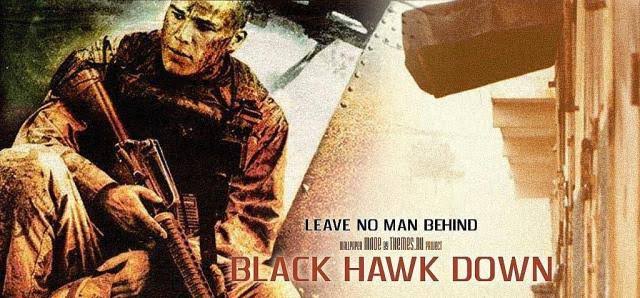
Released just a few months after the 9/11 attacks, Ridley Scott’s Black Hawk Down[2] arrived as the first war film of this new era, marked by a notable militarist shift in cinematic representations of American geopolitical conflicts overseas. The movie depicts the true story of a 1993 U.S. military raid in Somalia turned into a near-impossible rescue mission of over a hundred soldiers who “found themselves” surrounded and outnumbered by the Somali National Alliance’s militia fighters. The operation, which was meant to capture prominent members and commanders of the militia and secure food aid, has been undermined by a sharply contradicting more recent account of Somali authorities suspending members of a US-backed commando unit for stealing and reselling food rations[3]. While images of US soldiers being dragged through the streets of Mogadishu caused immense shock and disbelief among Americans, the movie itself imbues the conflict with a rather eerie sense of romanticism despite its commitment to realism. Black Hawk Down follows a long-standing Hollywood tradition by glorifying military heroism and framing a violent war as a visceral tale of brotherhood, all while completely disregarding the Somali perspectives and accounts of the battle.
Unsurprisingly, the U.S. Department of Defense (DoD) and the Pentagon subsidized the film with 2.2 million dollars in military equipment and personnel. The DoD maintains that its partnership with Hollywood producers and filmmakers is designed solely to provide authentic representation without restricting creative freedoms.
Although the movie depicts a battle that precedes the September 11th attacks, one cannot deny the obvious influence of the subsequent “war on terror” on such widely celebrated cultural products. Such stereotypical and dehumanizing portrayals of this supposedly savage ‘Other’ have been deployed at the forefront of the empire’s ideological battle. Reminiscent of Edward Said’s central thesis, these representations take an active part in rearranging and constructing a new reality that positions the so-called Orient in juxtaposition to the West in order to sustain the narrative of threat, which is contingent upon the belief in this fictional binary.
From anti-communist hysteria to post-9/11 Islamophobia, American hegemony has always extended its reach by crafting existential enemies and amplifying this animosity through media spectacle. Its most powerful tactic is the production of alienation through hegemonic modes of cultural production, suggesting the media’s crucial role in curating a state-sanctioned culture of fear that lingers even decades after conflicts. Today, China finds itself the newest object of this ideological production of fear, portrayed as a looming threat that undermines Western democratic norms.
The outsourcing of geopolitical anxieties, once again, onto a new cast of constructed “Others” can only create more internal crises in a society as multicultural and racially diverse as the United States. In the same way that American Muslims have had to bear the brunt of post-9/11 state surveillance, other minority communities will inevitably become collateral damage in the pursuit of a new enemy through which the empire can justify its massive military spending and reluctance to provide free essential political goods to its citizens. For anyone closely monitoring the unfolding tech rivalry between the US and China, the parallels to past eras’ suspicions are hard to miss, as Chinese-American scientists find themselves under constant scrutiny, occasionally subject to racial profiling, and in many instances penalized for minor administrative errors. The question here is whether political leadership will succeed once again in mobilizing public fear to sustain a permanent war economy on a different front that has no particular geographic boundary or concrete goal.
Aya Anzouk is a writer and psychology researcher whose work focuses on social and political psychology, gender, and postcolonial studies. She explores social dynamics, power relations, and the ways societies shape perceptions of the self and the Other, with particular attention to North African perspectives.
[1] Wakeman, G. (2025, August 15). How the CIA Used ‘Animal Farm’ As Cold War Propaganda | HISTORY. HISTORY. https://www.history.com/articles/animal-farm-movie-propaganda-cia-orwell
[2] Gosztola, K. (2021, September 18). 9/11 Cinema: The War film Dick Cheney fell in love with. The Dissenter. https://shorturl.at/1z6SJ
[3] Agence France-Presse. (2024, April 27). Somalia detains members of elite army unit for theft of rations. Voice of America.https://www.voaafrica.com/a/somalia-detains-members-of-elite-army-unit-for-theft-of-rations/7587036.htm

