By Fei Yang
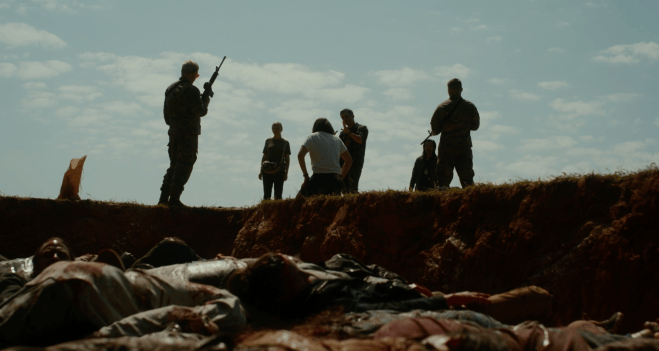
Approximately two-thirds of the way through Alex Garland’s 2024 film Civil War, the central characters find their journalist colleagues Jessie and Bohai kneeling next to a mass grave, held at gunpoint by two white men in military uniforms. Joel, Lee and Tony cautiously approach the men, who ask what they are doing in the area. Not knowing which side the men are on, Joel comes up with a politically ambiguous lie. Unimpressed, the man asks flatly, “This guy is your colleague?” gesturing at Bohai. Joel nods. The man shoots and kills Bohai. The camera cuts to Jessie, who is now hyperventilating. Joel lifts his hands in a pacifist gesture and pleads, “We are American, okay?” The man, irritated and losing patience, replies, “Okay. What kind of American are you?” Joel is silent. “Central American? South American?” “Florida,” Joel says. The man, eyebrows raised, retorts, “Central.” He points his gun at Joel, who tenses up, before turning to Jessie and asking her the same question. “Missouri,” Jessie eventually utters. He chuckles and nods. “It’s American. Hundred percent.”
Tony, who has been standing behind Joel and mostly kept out of frame or shown blurrily in the background, now comes into focus. He is sobbing silently and frozen with fear. The man notices Tony, walks up to him, and asks where he is from. Tony shakes his head and makes incoherent sounds. Pointing his gun directly at his chest, the man says, “Tell me where you’re from. Just make sure it’s clear fucking English. Okay?” “I’m from Hong Kong,” Tony manages to say. “Oh- China.” The man shoots Tony point-blank. He turns back to the others, and the scene erupts into chaos. Jessie is screaming, Lee is crying, and Joel is yelling at him to stop. The man points his gun at Joel and advances while Joel frantically pleads and backs away. Suddenly, the camera cuts to the group’s press van speeding towards them. The van hurtles into the armed men, driven by their colleague Sammy. The camera then focuses on Jessie, who fell into the grave amidst the chaos of the collision. In slow motion, she realizes she has landed in the mass of bodies, and her eyes widen in horror. The scene loses all diegetic sound, and eerie, off-tune music begins playing. The entire scene is devoid of music until this moment. An overhead shot shows Jessie amidst the expanse of corpses and follows her as she crawls over them to the edge of the grave. Diegetic sound returns and the scene reverts to normal speed when Joel pulls her out. The group runs to the van and escapes while getting shot at. In the car, Jessie and Joel stare at each other in shock. Jessie screams while Joel sobs, but we only hear the blaring music.
Civil War is a dystopian action-war thriller that follows a small group of journalists traveling to Washington D.C. amidst a civil war in which rebel forces are attempting to overthrow the federal government. Throughout the film, the journalists encounter and document various scenes of violence that showcase the nation’s deterioration.
The occupation of photojournalism has historically held itself to the norm of objectivity, claiming that the goal of journalism is to be impartial and that the medium of photography is capable of capturing unmediated reality. The purpose of photojournalists is to document events without bias. In the film, Lee embodies the practice of objectivity and serves as Jessie’s mentor. Early on in the story, she tells Jessie, “We don’t ask. We record so other people ask. Want to be a journalist? That’s the job.”
Throughout the film, photographs taken by the journalists are represented as stills. Oftentimes, the act of taking a photo is followed by a momentary interruption of the scene with the corresponding still. In one scene, Jessie and Lee look through photos Jessie took during a shootout. The audience was previously shown many of the photos as she took them. Jessie is embarrassed by most of them, but she pauses on one. It stands out from the others that were shown as stills: while the rest were in color, this one is revealed to the audience in black and white. “That’s a great photo, Jessie,” Lee remarks.
Besides the fact that they are unmoving images, there is no clear distinction between the framing of the photographs and the framing of the film itself. The photographic stills are taken directly from the moving image which was already being shown to the viewer. In other words, the film’s cinematography mimics the photographic eye of its photojournalist characters. The film thus claims to function as a photojournalist itself, capturing these moments and directly relaying them to the viewer.
Furthermore, the scenes which the central characters pass through are not motivated by any internal logic. They feel disconnected and episodic, momentary flashes briefly illuminating scattered snapshots of the film’s unfamiliar world. There is no overt narrative explanation as to why the journalists should first stop at a gas station, then accompany militiamen overtaking a building, then spend the night at a refugee camp, then visit an idyllic suburban town. This structure mimics our imagistic memory, whereby personal and global events are understood in disjointed visual moments. Our view of the world is mediated and concretized through the photos brought back to us by journalists. Again, the film claims to play the role of the reporter through its narrative structure.
By claiming the existence of “good” representation in photography and then echoing the style of this effective photography, the film claims that its mode of representation can also achieve objectivity. In the scene of Bohai and Tony’s deaths, there are no photos taken. The photojournalists cannot document, because they are no longer mere witnesses to violence- they are subject to it, they are its direct target. The film must now take on their job of documentation, and the audience must bear witness. In every other violent scene, the journalists are detached enough to be able to capture the violence through photos. This is the only violent scene where no pictures are taken. Here, the film itself takes a stab at capturing violence in a way that follows Lee’s advice, hoping to objectively communicate to its viewers the wrong that has occurred.
Civil War conveys its anti-war messaging through its representation of war photography. However, such images of violence can serve to objectify their subjects and reproduce hierarchies of power. Allissa Richardson (2021) writes that, despite recognizing the power in having visual proof of police brutality, she became disturbed when she realized that Black deaths were the only ones that the media felt comfortable airing in such a voyeuristic fashion. When there is already so much proof available, she argues, the circulation of such footage accomplishes little more than retraumatizing Black audiences and objectifying them for white audiences. War journalism can perpetuate a disinterest in understanding the harms faced by these subjects, which perpetuates the harms themselves. The ambivalent ethical implications problematize the objectivity ideal in photojournalism, undermining any claim that one might make to represent one’s subjects prior to the enforcement of any value systems.
Protagonists Lee and Jessie undergo significant change in their relationships to war photography as a result of their repeated encounters with violence, and Civil War argues for a proper way to witness violence through their opposing character arcs. For most of the film, Lee is cool-headed and unsentimental. Her decades of experience as a war photographer bestowed upon her the ability to deal with volatile situations calmly, rather than allowing herself to get paralyzed in the moment. By contrast, Jessie starts out struggling, too distressed to take action when confronted with violence. Alongside Lee, Joel also guides Jessie in subtler, more paternalistic ways. During the shootout, Joel physically protects Jessie by holding onto her vest strap the entire time and pulling her out of harm’s way when she eagerly surges forward to take photos. Joel has a fetishistic interest in violence and openly admits to getting aroused by it. As the film progresses, Jessie takes on his personality and increasingly seeks out thrills. After Bohai and Tony’s murder, Jessie tells Lee, “These last few days- I’ve never been scared like that before, and I’ve never felt more alive.” Early on in the climactic scene, the film suggests that Jessie has taken on Joel’s gleeful stance toward violence through her use of sexually suggestive dialogue. “We’re so fucking close,” she says breathlessly, before snapping a photo of the White House mid-breach. Jessie becomes reckless in the face of violence, repeatedly putting herself and others in danger in order to get the money shot. In the film’s culminating scene, Lee sacrifices herself to push Jessie out of the line of fire, and Jessie coldly uses this as an opportunity to capture the moment of Lee’s death. This scene gives a clear sense that something has gone wrong in Jessie’s development. The film uses her arc to warn against taking on the wrong kind of unsentimentality, the kind that views violence coldly, as an opportunity for a sensational thrill. Proper witnessing of violence, the film argues, does not look like this.
While Jessie’s path to proper documentation is thwarted by her desire for thrill, Lee completely loses faith in the power of documentation. Even at the beginning of the film, Lee is shown to be haunted by the horrors she has witnessed and questions the ability of photojournalism to prevent more horrors from occurring. In one conversation she has early on with Sammy, she says, “Every time I survived the war zone, got the photo, I thought I was sending a warning home: don’t do this. But here we are.” Sammy is her close friend and mentor, and after he dies from gunshot wounds, she completely stops taking photos. One might argue that, since we are made to identify with Lee, the film must agree with her eventual conclusion about the failure of communicating these scenes of violence. However, if Garland did not believe in the power of representation, then he would not have made this film. Instead, the film uses Lee’s disillusionment to emphasize that it is not enough for journalists to know the proper way to document; audiences also need to know the proper way to engage with what is documented. Civil War is a cautionary tale about polarization. The film intentionally avoids being specific about the ideologies of its various combatants, because it doesn’t want the viewer to concern themselves with which side is right. The main secessionist movement in the film, called the “Western Forces,” is an alliance between Texas and California. The film’s political situation is an intentionally absurd one, abstracted away from our current left- versus right-wing state of affairs. The combatants in the secessionist movements are still dressed like classic American soldiers, despite aiming to take down the American government.
Approximately halfway through the film, the journalists find themselves caught in the middle of a sniper battle. When Joel asks one of the men what side they are on and who they are shooting at, the man says curtly, “Someone’s trying to kill us. We’re trying to kill them.” The other sniper has painted nails and bleached hair, representing a stereotypical liberal urban hipster. The effect is visual discordance when paired with his ghillie suit and sniper rifle. The overarching idea is that political differences become irrelevant once people escalate to the point of violence. All ideological commitments are ultimately capable of being hollowed out. Previously held ideological affiliations have dissolved by the point in time when the film chooses to introduce us to its narrative world. The film is intentionally non-understanding of the ideological underpinnings of its conflict, arguing that these will not matter beyond a certain point.
In the final scene of the film, the Western Forces soldiers have captured the president, and they shoot him dead as viewers watch from the perspective of Jessie’s camera. His body jolts in slow motion while lighthearted music plays. It’s a moment of gratifying vengeance, but this sense of gratification also serves as a critique. After this final shot, we see a photo being developed behind the text of the closing credits. In it, the soldiers smile at the camera while kneeling next to the president’s dead body. It is a war trophy photograph, like those of American soldiers posing next to their Iraqi prisoners mid-torture at Abu Ghraib. By inviting comparisons to real life war crimes, the film criticizes its viewers who take pleasure in the fantasy of brutalizing one’s enemy. Garland’s usage of cheerful music in this scene calls back to the shootout scene earlier in the film, when upbeat hip hop music plays as we watch the building’s occupants get captured and brutally executed. This choice is meant to be jarring and somewhat disturbing, perhaps reminiscent of action movies, which often use exciting music in fight scenes to make the violence more entertaining. In the case of the final scene, we are asked to reflect on the pleasure we gain from watching the president’s assassination. The film shows us the catastrophic consequences of letting such indulgent extremist fantasies play out. As the credits roll, the question remains of what is to be gained from such antagonism. The film thereby urges its viewers to stop their political differences from heightening to violent reality.
The ideological project of neoliberalism is to foster a political culture which opposes antagonism and legitimates its policy through a pretense of objectivity. As an economic project, neoliberalism aims to reduce the government’s intervention in the economy. Policies should prioritize market efficiency, and solutions to social problems should be driven by market forces. Income inequality and monopolization of production worsen while critical responses to these crises are dulled because the public has largely withdrawn from the political sphere.
A primary goal of neoliberal ideology is to render itself invisible in order to obscure the existence of viable alternatives and make its policy seem objective and natural. This formulation of governance suppresses political contestation against the particular class interests that it serves. Those who oppose the ruling class interests protected by neoliberal policy are viewed as dangerous extremists, especially if their methods are systemically disruptive. These populations are excluded from democratic participation, creating a deliberative democracy that is built upon exclusionary consensus.
Civil War patronizes ideological commitments and aims to make lack of belief a noble pursuit. It argues for a way of seeing reality that is objective, rather than being limited by one ideological lens. Any claims it might make, the film suggests, operate on a more fundamental level beyond politics.
Garland wrote Civil War during the coronavirus pandemic, and the scene of Bohai and Tony’s death gestures directly at the violence experienced by Asian Americans during this period. In the scene, Tony and Bohai are the only two characters killed, and the film asserts that this is simply because they are foreigners, both from Hong Kong. The scene criticizes xenophobia and the violence that it motivates. At the same time, it enacts its own dehumanization of marginalized groups by dramatizing their brutalization and perpetuating a disinterest in understanding them as human beings.
First, this scene leverages the suffering of its marginalized characters by relying on shock and suspense to communicate its message. The fake-out moment in which the armed man points his gun at Joel before turning to Jessie serves no narrative purpose- it is only included as a trick to heighten the sense of tension, using the audience’s knowledge that Joel is in greater danger because of his racialized status. The film plays with the audience’s anxiety by highlighting the characters’ emotional distress through close-up shots before deploying sudden bursts of violence. Many of the shots are filmed from Tony’s point of view, as we watch the armed man converse with the others from behind Joel’s shoulder. Through this use of perspective, we are implicitly made to identify with Tony in order to heighten the sense of tension. We take refuge in hiding behind Joel, which increases our terror when the man, in effect, turns his attention to us. Tony’s suffering is made into a spectacle to feed the audience’s pity and emotional distress. Bohai’s murder, on the other hand, is carried out completely unceremoniously. His death is used, both by the armed man and by the film itself, to show that the man is serious about the threat he poses. The suffering and deaths of Tony and Bohai are instrumental for the narrative. After they die, their faces are never shown again. Tony’s body disappears from the frame before it even hits the ground. The narrative and visual focus immediately moves on to the terror felt by the still-living. It is the threat of more death which motivates the progression of the scene.
Secondly, both of them are notably underdeveloped as characters. They are introduced in the scene immediately prior to this one, and the viewer is given very few opportunities to connect with them or understand who they are. We learn that Tony is fun-loving and somewhat reckless. We learn nothing about Bohai. Typical of marginalized characters in dominant cinematic practices, they are fated to become defined by their suffering. In the process of conveying its political message, the film exploits the marginalized groups that it represents, using them as means to its rhetorical end. Sammy, a Black man who dies as a result of the gunshot wounds he suffered in this scene, is also exploited: his death is used to push Lee’s arc forward. A racialized iteration of the ‘fridging’ trope, his loss haunts her, fueling her psychological disintegration.
The primary subjects of this scene, and the film as a whole, are not Tony, or Bohai, or Sammy, but the ones who remain after they die, the ones who bear witness to and are traumatized by their brutalization. Besides the fact that it narratively focuses on journalists, Civil War reiterates through visual language cues that the people who are subject to violence merely serve as the backdrop for the real subjects- the witnesses. In one of the first scenes of the film, Lee and Jessie are at a protest, mid-violent struggle between civilians and police officers. The fighting occurs in the space between the photojournalists and the camera. In the shot, the journalists are in the center, framed on both sides by the blurry shapes of fighting protestors and officers. The deaths of Tony, Bohai and Sammy reveal the psychology of the white journalists more than anything else. In addition to the terror generated by the threat of violence, there is another terror produced by the scene- that of uselessness. The trauma these journalists are left with is induced at least in part by their inability to save the other characters. The journalists are unable to do anything other than be passive witnesses. In the face of global and local traumas—the brutalization of Black and brown people by the police and masked federal agents, the hate crimes committed against Asian Americans by white nationalists—witnesses feel the guilt of impotence and seek catharsis for that guilt.
The scene of Tony and Bohai’s death reveals the surface-level realism of Civil War. Although the film humanizes Tony by way of psychological realism, depicting his emotional response to the volatile situation, this humanization is limited to the immediate physical experience of overwhelming terror. Bohai, on the other hand, is not even granted the affordance of psychological interiority. The viewer can only empathize with them to the extent of suffering as a basic creatural experience. Creatureliness is expressed throughout the film in the form of dead bodies shown on screen, but it is expressed most heavily in the scene following Sammy’s death, when Lee has to clean up Sammy’s blood from the seat of the van, and it completely soaks the rag and her shirt. The film stresses that violence is a physical act, highlighting Sammy’s creatureliness to emphasize the permanence of his death.
Civil War is in the business of restaging traumas. Within the narrative, Civil War’s journalists are poised behind their cameras, documenting the brutalization of marginalized people. On the level of cinematic construction, Civil War itself screens and reproduces the brutalization of its marginalized subjects who function as signifiers of real people. The scene of Tony and Bohai’s death is a close-up, immersive representation of violence that momentarily lends a sense of being present in the scene. In reality, a team of actors, cinematographers, sound designers and editors collaborated in a carefully arranged process to enact mastery over these fictional subjects. The film’s mode of representation is itself a form of violence, serving to dehumanize its subjects and reinforce value hierarchies such as racial stratification. By claiming to access violence objectively through experiential immediacy, the film obscures the power dynamics inherent in its brutal realism.
Garland’s other films are also guilty of the violence of objectivity. The most prominent example of this is Warfare (2025), his subsequent project which he co-directed with former US Navy SEAL Ray Mendoza. The film follows a platoon of American soldiers on a surveillance mission gone wrong during the Iraq War. The press coverage surrounding this film places special emphasis on its realism and authenticity, as it plays out in real time and is entirely based on memory. Many audience members, as well as people involved in the filmmaking process, insist that the film is anti-war due to its un-glorified, traumatic depiction of combat and its emphasis on the psychological toll it takes on the soldiers. This interpretation assumes that the aims of war propaganda are incompatible with the recognition that war is a horrifically traumatizing experience. Removed from its political context and told entirely from the perspective of American soldiers, Warfare dehumanizes the Iraqi men they are fighting against and compels its viewers to identify with the soldiers and their struggle to dominate their enemy. The film justifies American imperialism while claiming to be objective by immersing its viewer in the brutal experience of combat.
In Civil War, violence is depicted without context, committed by and against anonymous subjects. This anonymized representation of violence echoes how many media outlets in the US cover conflicts across the globe. By setting the civil war in the US, the film turns this impersonal mode of witnessing inward into America’s own populace. The film’s audience is encouraged to view the violence in its own communities—against people of color, against immigrants—in the same depersonalized and homogenous way that they view violence in foreign nations. Viewers are also encouraged to understand the violence of systemic disruption as radically dangerous. Disruptive forms of political expression used by those excluded from the deliberational sphere, from riots to armed struggle, are not made invisible but rather relegated to a certain kind of visibility that delegitimizes their actions and construes them as extremist and irrational. In the film’s opening scene, the president is shown preparing to deliver a speech, periodically interspersed with cuts to real-world footage of police and rioters, painting a picture of a nation in disarray. By combining these clips together, the film erases the distinction between methods of domination and methods of resistance. It is a pro-peace stance which does not distinguish between an unjust peace that maintains the imperialist status quo and a just peace that requires overcoming occupation.
The claim to objectivity induces passivity, reinforcing an ideological disposition that takes representation for granted as reality. Representations which claim objectivity disempower their subjects and viewers alike: they normalize the violence committed against their subjects and render their viewers complicit in this violence. Countering structural violence necessitates understanding that the act of representation can be its own form of violence.
Author bio: Fei Yang studied comparative literature and philosophy in her undergrad at UC Irvine. She currently works in the legal field.
Works Cited
Civil War. Directed by Alex Garland, A24, 2024.
Richardson, Allissa V. (2021). “We Have Enough Proof.” Vox, 2021,
https://www.vox.com/firstperson/22391964/george-floyd-derek-chauvin-adam-toledo-police-viol ence.

